


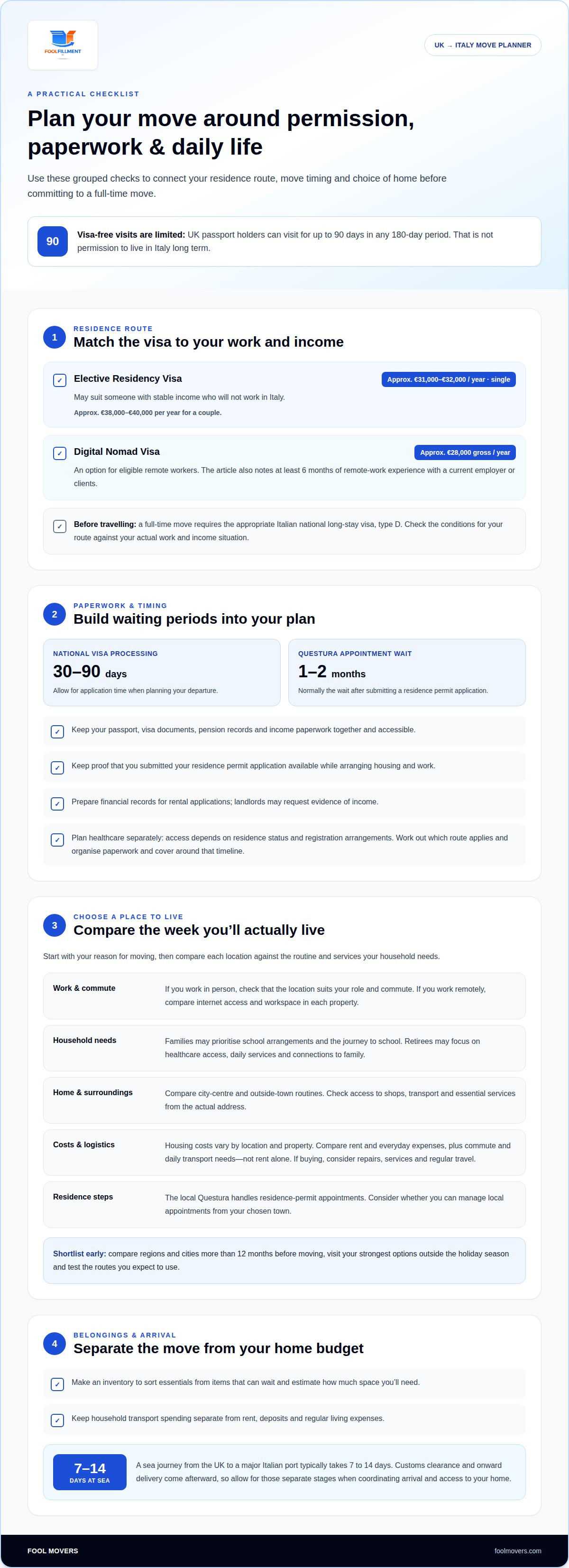
You can move to Italy from the UK, but visa-free entry isn’t permission to live there long term. If you’re relocating to Italy from the UK for full-time residence, you need an Italian national long-stay visa, type D, before travelling. UK passport holders can visit visa-free for up to 90 days in any 180-day period.
It’s easy to focus on the dream of a home in the sun. But choosing where to settle involves more than the view: your visa route, work or income, housing plans and everyday needs all matter.
This guide explains how post-Brexit rules affect relocating to Italy from the UK and what to consider when renting or buying. It also offers a practical way to compare Italian regions and cities, helping you narrow your options before choosing a new home.
Key Takeaways
- For a full-time move, plan around the Italian long-stay visa rules; a visa-free visit of up to 90 days in any 180-day period isn’t permission to settle.
- Look beyond scenery when comparing places to live. Think about work, income, housing and the routines you want day to day.
- Find out which documents need translation or legalisation for your visa and personal plans, so paperwork doesn’t disrupt your move.
- Once your plans are set, match your belongings and transport needs to the right home-removal support.
Can you move to Italy from the UK?
Yes. Relocating to Italy from the UK is possible, but the right route depends on why you’re moving and how you’ll support yourself. A full-time move requires the appropriate long-stay permission; a short visit does not establish long-term residence.
For example, Italy’s Elective Residency Visa may suit people with stable income who won’t work there. Its income threshold is approximately €31,000-€32,000 per year for a single applicant and €38,000-€40,000 for a couple. The Digital Nomad Visa is another option for eligible remote workers. It requires gross income of approximately €28,000 per year and at least 6 months of remote-work experience with a current employer or clients. These routes have different conditions, so match the visa to your actual work and income situation.
Healthcare needs a separate plan. Healthcare access in Italy depends on your residence status and registration arrangements. Don’t treat arrival in Italy and healthcare registration as the same step. Work out which registration route applies to your residence status, then arrange the paperwork and cover around that timeline.
That figure matters if you need voluntary enrolment, but it isn’t a universal fee for every UK national. Your employment, residence status and registration route affect how you access care. For example, the route for a pensioner may differ from that for a remote worker earning income overseas.
Before travelling, note your expected arrival date, visa route, registration steps and any private insurance you plan to use. Compare the policy’s cover for routine treatment and prescriptions with your likely needs. Keep proof of legal residence and healthcare registration together so you can provide it when arranging care in Italy.
The section covers the Elective Residency Visa for people with stable income who will not work in Italy, and the Digital Nomad Visa for eligible remote workers. It does not explain other work, family or study visa options.
Post-Brexit rules for UK citizens moving to Italy
UK citizens planning to live in Italy full-time need to consider immigration, household budgets and paperwork together. Housing costs vary by location and property, so compare rent and everyday expenses before choosing an area.
Common risks include travelling without the right visa, a gap before healthcare registration and missing a required residence step. Remember to review tax records when your residence status changes.
UK Administrative Steps
Before leaving the UK, organise your personal records and administrative arrangements. Accurate, accessible paperwork can be essential for Italian applications and financial matters.
Keep your passport, visa documents, pension records and income paperwork together. An Italian national visa typically takes 30-90 days to process, so include application time in your departure planning. Keep these official application costs separate from your housing budget.
After submitting a residence permit application, the wait for a local Questura appointment is normally 1-2 months. Keep proof of submission accessible while you arrange housing and work in Italy. For a rental application, prepare financial records, since landlords may request evidence of income.
Moving Belongings and Removals
Moving belongings means deciding what to take and planning how to get it to your Italian home. An inventory helps separate essentials from items that can wait, and clarifies how much space you’ll need.
Separate household transport spending from rent, deposits and regular living expenses. Compare housing options alongside commute and daily transport needs, rather than choosing by rent alone. If you’re considering sea freight, the sea journey from the UK to a major Italian port typically takes 7 to 14 days, before customs clearance and onward delivery. Allow for those separate stages when coordinating arrival and access to your home.
Choosing where to live in Italy
The best place to live depends on how you’ll spend an ordinary week, not just what looks appealing in holiday photos. Before moving to Italy, compare work options, housing, transport and access to the services your household uses. A shortlist of regions and cities more than 12 months before moving gives you time to test practical details, not just browse property listings.
Start with your main reason for moving. If you need to work in person, focus on places that suit your role and commute. If you work remotely, compare internet access and workspace in each property. Retirees may prioritise healthcare access, daily services and connections to family. For families, school arrangements and the journey to school may matter more than a scenic view.
Then compare the home and its surroundings. A city-centre flat and a home outside town offer different routines, even within the same region. Check whether shops, transport and essential services are accessible from the address. If you’re buying, consider more than the property itself: the location should also work for repairs, services and regular travel.
Your residence process is another practical factor. After you arrive, your local Questura handles residence-permit appointments. The wait after submitting an application is normally 1-2 months, so consider whether you can manage local appointments from your chosen town. A permesso di soggiorno is the Italian residence permit. Your address and local arrangements should make it straightforward to handle the paperwork and attend the required appointment.
Before committing, make a simple comparison: list your must-haves, visit your strongest options outside the holiday season and test the routes you expect to use. If you’re choosing between countries as well as Italian regions, compare your full weekly routine, not just rent. The right place is one that supports your work, household and daily needs after the initial excitement wears off.
What documents need translating, legalising or apostilling when relocating from the UK to Italy?
There isn’t one document pack for every move. The paperwork depends on what you’re applying for and which Italian body receives it. Visa applications, residence permits, property purchases, school enrolment and family registration can require different records. Sort documents by purpose, then establish whether each needs an Italian translation, legalisation or an apostille.
Create a folder for identity and immigration records. Include your passport, visa paperwork and residence-permit documents, and keep copies alongside the originals. An Italian residence permit application asks for four passport-sized photographs. That specific requirement doesn’t mean every document in your folder needs an apostille or translation.
Keep civil-status records, such as birth, marriage or name-change certificates, together. These may be needed to establish your identity or family relationship for an Italian process. Education, employment, pension and income records serve different purposes, such as school enrolment or documenting your financial circumstances. Label each file by its purpose rather than treating all UK paperwork alike.
Translation, legalisation and an apostille are different document treatments. Translation addresses language; legalisation or an apostille concerns a document’s formal acceptance. What’s required depends on the document, its issuing body and the Italian process where you’ll use it. Don’t assume an English-language original will be accepted, or that every translated record needs further authentication.
For each document, note its issuer, date, intended use and current format. Keep the original, a clear copy and any completed translation together. For family documents, check that names and dates match across passports and certificates. This makes discrepancies easier to catch before submitting a visa, residence-permit or school file.
File immigration documents separately from property paperwork and personal records. This makes it easier to find the right version when an Italian office, school or other institution requests a specific item. It also helps prevent an apostille or translation prepared for one purpose from being mistaken for a universal requirement.
Fool Movers: Home Removals
Fool Movers handles small home removals on routes it serves. For a separate move within its service network, such as transporting furniture across its nationwide coverage in the Netherlands, its Furniture & Other Items service may be suitable. Motorcycle & Scooter transport is another option for a separate move.
Make a clear inventory of your items, collection point and delivery point. This helps define the transport needed for a move on a route Fool Movers serves.
For details about a separate move within its service area, visit Fool Movers.
Turn your move plan into a clear next step
Keep your Italian relocation plans separate from any transport request. Fool Movers can help with a separate move between countries on its service network, but not with delivery from the UK to Italy.
If you’re relocating to Italy from the UK and need help moving belongings on a route Fool Movers serves, clearly describe that separate transport request. Include the collection point, destination and items to be moved.
For a separate move within its service area, contact Fool Movers about your transport needs. Take the next step with a plan that fits the route.
Frequently Asked Questions
How long does shipping from the UK to Italy take?
Sea freight from the UK to a major Italian port typically takes 7 to 14 days, before customs clearance and onward delivery. That is the sea journey, not the full door-to-door timeline. For example, delivery to a home inland also involves clearance and transport from the port. Build those stages into your schedule, especially if your arrival date depends on having household items available.
Is moving to Italy easy?
Relocating to Italy can be manageable with a clear plan, but it involves more than booking transport. Full-time movers need the right residence route, suitable housing and plans for healthcare, income and paperwork. For example, someone moving for remote work must organise their work arrangements alongside immigration steps. Break the move into decisions, and sort out documents and accommodation before arranging transport for your belongings.
Do UK citizens need a visa or residence permit to move to Italy after Brexit?
Yes. UK citizens moving to Italy for full-time residence need an Italian national long-stay visa, type D, before travelling. After arrival, they must apply for a residence permit within 8 working days. A short visa-free visit doesn’t replace these requirements. UK nationals who were legally living in Italy before 1 January 2021 are covered by Withdrawal Agreement rights, so their situation differs.
How do UK citizens register residency with an Italian municipality (Comune)?
Contact the Comune responsible for your Italian address and follow its process to register your residence. This local registration is separate from immigration paperwork, such as a residence permit. If you move to a new address in another municipality, the local office responsible for that address will handle the relevant registration. Keep proof of accommodation and immigration documents together so you can provide the records required for your case.
How can UK residents access healthcare in Italy, and what does private health insurance cost?
Access to Italy’s public healthcare depends on your residence status and registration route. Private insurance prices vary by policy and cover, so compare what each plan includes before choosing. Consider your expected care needs and whether the policy covers routine treatment or prescriptions.
How do you move household goods, pets and a car from the UK to Italy, including customs rules and fees?
Plan household transport and customs paperwork around your belongings and move circumstances; charges depend on the applicable requirements. For pets, a rabies vaccine must be given at least 21 days before entry, and an Animal Health Certificate is valid for 10 days from issue. If you become resident in Italy, you cannot drive a foreign-registered car there after 90 days or more of residence.
Disclaimer
Website & Blog Disclaimer
Last updated: September 2026
The information published on Foolmovers.com, including articles, guides, tips, FAQs and other editorial content, is provided for general information and guidance only.
Accuracy of Information
Foolmovers makes reasonable efforts to ensure that the information published on this website is accurate and useful at the time of publication. However, information can change without notice, particularly regarding customs procedures, import and export requirements, transport regulations, documentation, taxes, duties, prices, travel restrictions and local regulations.
We therefore cannot guarantee that all information will always be complete, accurate or current.
No Professional Advice
Information published on Foolmovers.com should not be regarded as legal, tax, financial, customs, immigration or other professional advice.
Every international move is different. Requirements may depend on the countries involved, your personal circumstances, residency status, the goods being transported and current legislation.
For important decisions, you should verify the latest requirements with the appropriate authorities or a suitably qualified professional.
Customs & International Moves
Customs regulations and documentation requirements can change and may be interpreted differently by authorities in different countries.
Although Foolmovers can assist customers with transport documentation and customs procedures where applicable, information provided in our articles does not constitute a guarantee that a shipment will be accepted, cleared or exempt from duties, taxes, inspections or additional charges.
Any customs duties, taxes, government charges or third-party fees remain subject to the applicable authorities and service providers unless expressly agreed otherwise.
Prices & Costs
Any prices, rates, fees or cost estimates mentioned in our articles are provided for general guidance unless explicitly stated otherwise.
Actual transport, storage, customs and related costs may vary according to route, volume, dates, availability, fuel prices, tolls and individual circumstances.
For an accurate moving price, please request a personalised quotation from Foolmovers.
Third-Party Websites
Our articles may contain links to external websites, authorities, businesses or other third-party resources.
These links are provided for convenience and additional information. Foolmovers does not control these websites and cannot accept responsibility for their availability, accuracy, content, security or privacy practices.
The inclusion of an external link does not necessarily mean that Foolmovers endorses the organisation, service or information concerned.
Limitation of Liability
To the extent permitted by applicable law, Foolmovers cannot accept liability for losses, damages, costs, delays or other consequences resulting from reliance solely on information published in our articles, guides or other general website content.
Nothing in this disclaimer excludes or limits liability where doing so would be prohibited by applicable law.
Your Individual Move
Information found in one of our articles may not apply exactly to your situation.
If you're planning a European move, contact Foolmovers directly. We can look at your specific route, volume, dates and requirements and provide information relevant to your move.
Foolmovers
Small European Moves, Done Right.


