


A small European move is sized by the belongings going, not just by the size of your home. When getting a quote for a small European move, look for the stated volume, route, included services, insurance, extra costs and 21% VAT. A small move in the Netherlands typically covers about 3-15 m³, so an itemised volume estimate helps make the price meaningful.
It’s easy to focus on the headline total. But quotes are only comparable when they cover the same volume, services and responsibilities. Packing, travel time, storage and customs paperwork can affect what’s included, and the price may change if the actual load differs from the estimate.
This guide explains what a clear quote should show, which details affect the price and how to compare transport options for a small move from the Netherlands to another European country. You’ll also learn what to include in your request so the mover can estimate your belongings and route accurately.
Key Takeaways
- Compare quotes only when they cover the same belongings volume, services and responsibilities.
- Find out whether the price is fixed or can change with the actual load, extra trips or added services.
- Consider how transport, parking arrangements and possible extra costs affect the move plan.
- Use the volume of your belongings, not just your home size, to describe the move clearly.
What Should a Small-Move Quote Include?
A useful quote makes the load, route, services and possible extra costs clear. When getting a quote for a small European move, compare the same volume and responsibilities, not just the final total.
Quote Details and Personal Requirements
A complete quote should state the goods’ volume or weight, vehicle, number of movers, rate, estimated hours, travel time or fuel, and 21% VAT. It should also list included services, insurance, customs-document handling and additional costs. Distance, packing and loading time, and the volume and value of your furniture all affect the estimate.
Give the mover a detailed inventory and explain access, packing needs and any items for storage. A short phone or face-to-face conversation can help shape the plan. If you pack your own belongings, say so; it can change the work included. For damage, compare all-risk cover with limited liability cover, and understand the reporting and assessment process before accepting the quote.
Moving Service Options
A full-service quote may include packing and other tasks, while a shared-load quote covers space in a van carrying other customers’ belongings. A moving container is a different arrangement, so compare what delivery, loading and collection involve. Totals are comparable only when the volume, included work and responsibilities match.
For a move within the EU, ask for any route-specific paperwork to be listed in the quote. For a move to a European country outside the EU, customs clearance is handled by the mover or its partner. The mover may prepare customs documents and help with forms; you provide personal documents such as a valid passport, proof of registration and a detailed inventory.
There is no single total for every small international move. The price depends on distance, load volume and value, packing and loading time, and the chosen service. Ask whether the amount is fixed or may change with actual volume or extra trips.
Prepare a room-by-room inventory, separate items you will pack yourself, and flag furniture needing special handling. These details help the mover estimate the load and working time more accurately. Photograph belongings during loading and unloading, and keep the inventory as a record if you need to report damage.
Negotiating quote contents and fixed pricing
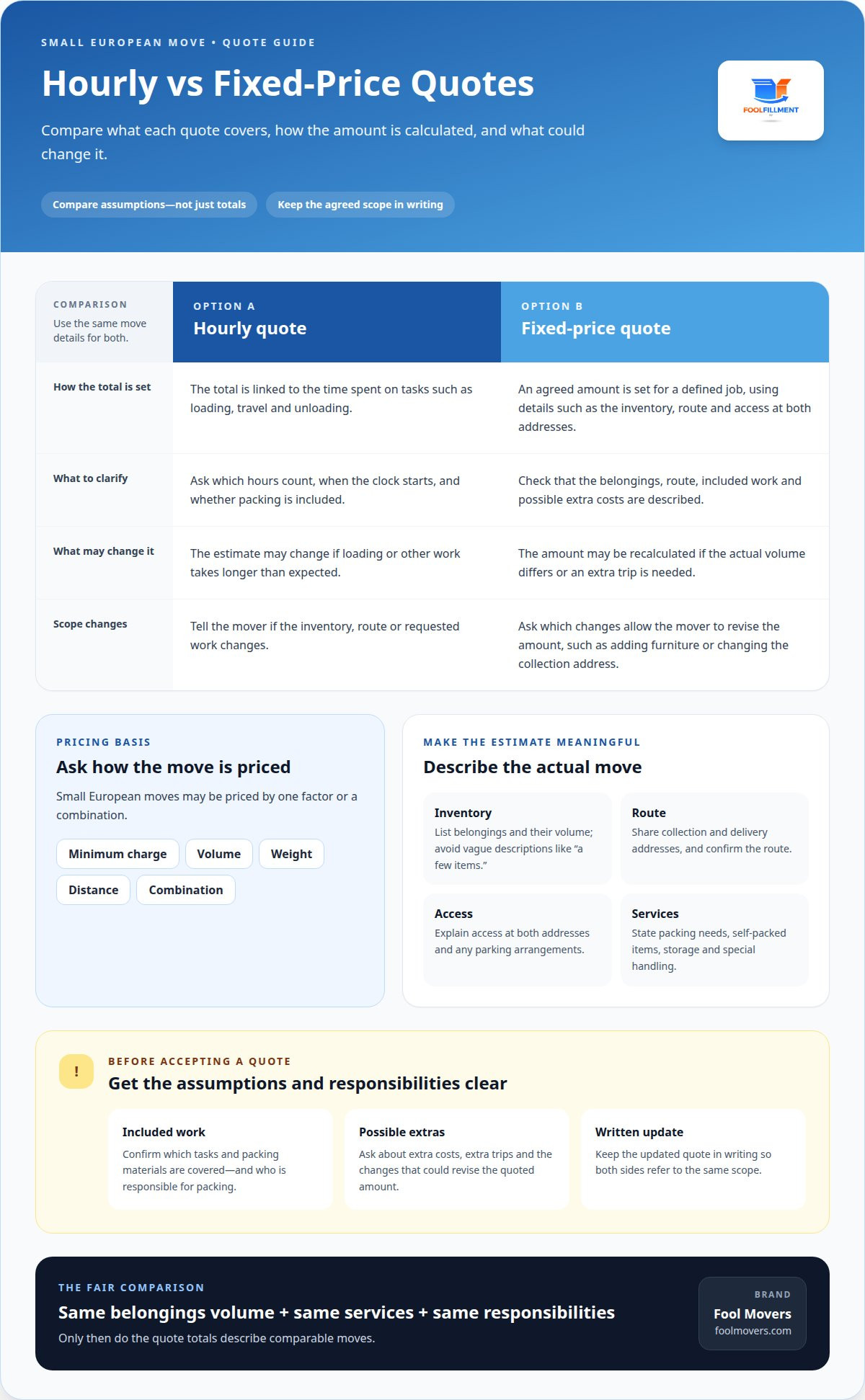
Small European moves may be priced by a minimum charge, volume, weight, distance, or a combination. Ask the mover to name the pricing basis and explain what could change the quoted amount.
Hourly and Fixed-Price Quotes
An hourly quote links the total to the time spent on tasks such as loading, travel and unloading. Ask which hours count, when the clock starts, and whether packing is included. A fixed-price quote sets an agreed amount for a defined job, based on details such as the inventory, route and access at both addresses.
Compare the assumptions, not just the format. For example, an hourly estimate may change if loading takes longer, while a fixed quote may be recalculated if the actual volume differs or an extra trip is needed.
Transparent Pricing and Fixed Quotes
Before accepting a fixed quote, make sure it describes the belongings, route, included work and any possible extra costs. Ask which changes allow the mover to revise the amount, such as adding furniture or changing the collection address. Clear terms let you discuss changes before moving day rather than discovering a new charge during the job.
Negotiate the scope first. If you’ll handle packing yourself, have that responsibility recorded; if the mover will pack, ask which items and materials are covered. Keep the updated quote in writing so both sides use the same version.
Small-Move Pricing Factors
Ask whether a minimum charge applies, then identify how volume, weight and distance affect the calculation. A small load can still involve a long route, while a short journey may require substantial loading time. The quote should explain which factor carries the most weight for your specific move and how the mover measures it.
For distance-based pricing, confirm the route and what travel the rate covers. For volume or weight pricing, provide an accurate inventory rather than describing the move only as “a few items.” An example such as a sofa, bed and packed boxes gives the mover a clearer basis for estimating the job.
Share your route and inventory before agreeing to a quote. If either changes, tell the mover so the plan and price reflect the move you actually need.
How do I choose an international moving company?
Choose a mover whose transport plan fits your route, load and delivery timing. For a European move, transit can take from a few days to a few weeks. Ask how loading, transport and unloading work, and who handles access at each address. A clear plan matters as much as the arrival estimate.
Compare transport modes and delivery arrangements. European moves commonly travel by road; international transport can also use sea freight or air freight. For a small load, shared transport may reduce costs, but delivery timing can be less predictable if the vehicle waits to fill. Overseas transit averages 6-8 weeks, so don’t apply that estimate to a European road move.
Check the loading plan before booking. If there’s no elevator, a street-level service may require you to carry belongings to ground level yourself. Ask who loads and unloads, where the vehicle can stop, and whether any parking permit or access arrangement is included. Get responsibility for arranging permits and any related costs stated in writing. This avoids confusion on moving day.
Also ask what could create additional costs. A customs inspection may happen on an international move, and related costs cannot be fully predicted in advance. For commercial road haulage in the Netherlands, the moving company must hold a NIWO Euro licence. Confirm that the company’s transport arrangement covers your route and belongings, then compare its written plan with the services in the quote.
Before deciding, share the collection and delivery addresses, inventory, access details and preferred dates. Ask how the mover will update you if the route or delivery timing changes. For a move beyond Europe, confirm how sea or air transport affects handling and transit. For a European route, focus on road transport, loading responsibilities, parking arrangements and the stated delivery window.
Defining a small move by home size and belongings volume
A small move is better measured by belongings volume than by the number of rooms. In the Netherlands, a small move typically contains about 3-15 m³, often fitting in one van load. A studio can still need more space than expected if it holds bulky furniture, while a larger home may have fewer items to transport.
Use each room as an inventory checklist, not as a final estimate of volume. List the sofa, bed, dining table, shelves, appliances and boxes separately. Include belongings in a loft, basement, shed or garage, since a room count alone can miss items that affect the load and transport plan.
To make the list useful, record each item’s type and size where possible. Note whether furniture can be dismantled, and count packed boxes rather than describing them as “a few.” Keep items staying behind off the moving list. This gives movers a clearer picture of what must fit together, including awkward pieces that take up space around smaller belongings.
- List furniture by room, such as a bed and wardrobe in the bedroom.
- Add boxes, bicycles and items from storage areas.
- Separate belongings staying behind from the moving load.
- Flag large or unusual items that may affect how the van is packed.
Home size is a useful starting point, but it cannot replace an item-by-item list. For example, two one-bedroom homes can have different loads if one includes a full bookcase, outdoor furniture and stored boxes. Describe the actual belongings first, then use the home layout to check for anything you may have missed.
Before requesting an estimate, walk through each room and check cupboards, balconies and storage spaces. Match the inventory to what you plan to move, not everything you own. This helps keep your volume estimate close to the actual load and makes it easier to choose suitable transport.
Fool Movers: Home Removals
Fool Movers can help when your move involves a small household load or selected furniture and other items. Its Home Removals service covers small moves up to 12 m³, with transport across the Netherlands and listed European countries. A driver helps with loading and unloading, so you can plan around the actual belongings and access at each address.
For a few pieces rather than a full home, Furniture & Other Items may fit the job. Fool Movers also offers transport for motorcycles and scooters, as well as Complete Relocation Solutions. Share your route, moving list and access details to get a quote that reflects your needs.
Ready to discuss your move? Visit Fool Movers.
Make your next move easier to plan
Before setting a moving date, turn your inventory into a practical plan. Decide what you’ll pack yourself and whether any items need special handling or separate transport. This gives your quote request a clear starting point, whether you’re moving household goods, selected furniture or a motorcycle.
Fool Movers offers Home Removals, Furniture & Other Items, and Motorcycles & Scooters. Share your route and moving list to start planning the service that fits. Getting a quote for a small European move is easier when it reflects the belongings you intend to take, rather than a rough guess based on home size.
Take the next step when you’re ready. Contact Fool Movers about your move, and move forward with a clearer plan.
Frequently Asked Questions
How do I get a quotation?
Send the mover your collection and delivery locations, preferred date and an itemised list of belongings. Include bulky pieces, such as a wardrobe or sofa, and note stairs, lift access or restricted parking at either address. Say what you’ll pack yourself and flag any items needing special handling. A conversation can clarify details an inventory may miss.
How do you know you are comparing apples to apples?
Match each quote against the same moving list, route and service scope. Check whether packing, loading help, travel, customs paperwork, VAT, insurance and storage are included or charged separately. Also compare the assumptions behind the estimate, such as access at both homes and the number of trips. A lower total may cover a different job, so compare each line before choosing.
How far in advance should I plan my move?
For an international move to or from the Netherlands, request a quote eight to twelve weeks before your planned date. Start earlier for popular routes such as the Netherlands to Spain, or for a summer move, when demand is higher and transport capacity is limited. Early planning also leaves time to prepare an inventory, confirm arrangements and organise packing without rushing.
How long does the moving process take, and how long will my belongings be in transit?
Transit times vary by route and transport plan. Separate travel time from the full moving process, which also includes booking, packing, loading and delivery arrangements. With shared-load transport, timing may depend on coordinating the load with other moves. Confirm the expected delivery window for your route.
What is included and excluded in a small international moving quote?
A quote should spell out the transport and handling it covers, then name any separate options. Packing, storage, insurance and customs-document assistance can affect the scope, so don’t assume they’re included. For a move outside the EU, customs clearance is handled by the mover or its partner. Make sure the quote says who handles each task and identifies possible additional costs.
How can I estimate the volume of belongings for a small European move?
Start with a room-by-room inventory, including cupboards, garages and other storage areas. Measure bulky items in metres, multiply each item’s length, width and height, then add those cubic measurements. Count boxes separately and note furniture that can be dismantled. This gives the mover a clearer starting estimate than a room count alone, while a conversation can help clarify unusual or awkward items.
Disclaimer
Website & Blog Disclaimer
Last updated: September 2026
The information published on Foolmovers.com, including articles, guides, tips, FAQs and other editorial content, is provided for general information and guidance only.
Accuracy of Information
Foolmovers makes reasonable efforts to ensure that the information published on this website is accurate and useful at the time of publication. However, information can change without notice, particularly regarding customs procedures, import and export requirements, transport regulations, documentation, taxes, duties, prices, travel restrictions and local regulations.
We therefore cannot guarantee that all information will always be complete, accurate or current.
No Professional Advice
Information published on Foolmovers.com should not be regarded as legal, tax, financial, customs, immigration or other professional advice.
Every international move is different. Requirements may depend on the countries involved, your personal circumstances, residency status, the goods being transported and current legislation.
For important decisions, you should verify the latest requirements with the appropriate authorities or a suitably qualified professional.
Customs & International Moves
Customs regulations and documentation requirements can change and may be interpreted differently by authorities in different countries.
Although Foolmovers can assist customers with transport documentation and customs procedures where applicable, information provided in our articles does not constitute a guarantee that a shipment will be accepted, cleared or exempt from duties, taxes, inspections or additional charges.
Any customs duties, taxes, government charges or third-party fees remain subject to the applicable authorities and service providers unless expressly agreed otherwise.
Prices & Costs
Any prices, rates, fees or cost estimates mentioned in our articles are provided for general guidance unless explicitly stated otherwise.
Actual transport, storage, customs and related costs may vary according to route, volume, dates, availability, fuel prices, tolls and individual circumstances.
For an accurate moving price, please request a personalised quotation from Foolmovers.
Third-Party Websites
Our articles may contain links to external websites, authorities, businesses or other third-party resources.
These links are provided for convenience and additional information. Foolmovers does not control these websites and cannot accept responsibility for their availability, accuracy, content, security or privacy practices.
The inclusion of an external link does not necessarily mean that Foolmovers endorses the organisation, service or information concerned.
Limitation of Liability
To the extent permitted by applicable law, Foolmovers cannot accept liability for losses, damages, costs, delays or other consequences resulting from reliance solely on information published in our articles, guides or other general website content.
Nothing in this disclaimer excludes or limits liability where doing so would be prohibited by applicable law.
Your Individual Move
Information found in one of our articles may not apply exactly to your situation.
If you're planning a European move, contact Foolmovers directly. We can look at your specific route, volume, dates and requirements and provide information relevant to your move.
Foolmovers
Small European Moves, Done Right.


