

A move to Ireland doesn’t automatically mean a customs bill. Moving personal effects to Ireland from another EU country usually brings no additional Irish customs duty or VAT, apart from exceptions such as vehicles. For a move from outside the EU, Transfer of Residence relief may cover qualifying used belongings if you meet the conditions, including owning them for at least 6 months before import.
It’s sensible to get clear on the rules before your belongings set off. What applies depends on where they’re coming from, what you’re bringing and whether you qualify for relief. This guide explains when customs duty or tax may apply, what Transfer of Residence relief can cover, and what to do if Ireland is a stop on the way to another EU Member State.
The rules also differ for personal belongings, recently purchased household goods, alcohol and vehicles. Knowing which category your items fall into helps you prepare the right paperwork and route, rather than assuming every shipment follows the same customs process.
Key Takeaways
- Sort your shipment by type before arranging transport. Used household effects, commercial goods, alcohol and vehicles can follow different tax and relief rules.
- If Ireland is a stop on the way to another EU Member State, plan for the destination country’s customs process and transit procedure.
- Gather evidence of residence and ownership early to support a Transfer of Residence application and keep shipment timing aligned with eligibility rules.
- Tell your haulier in advance that the belongings are personal, not commercial, and prepare an inventory or packing list for the journey.
Do I have to pay customs duty or tax?
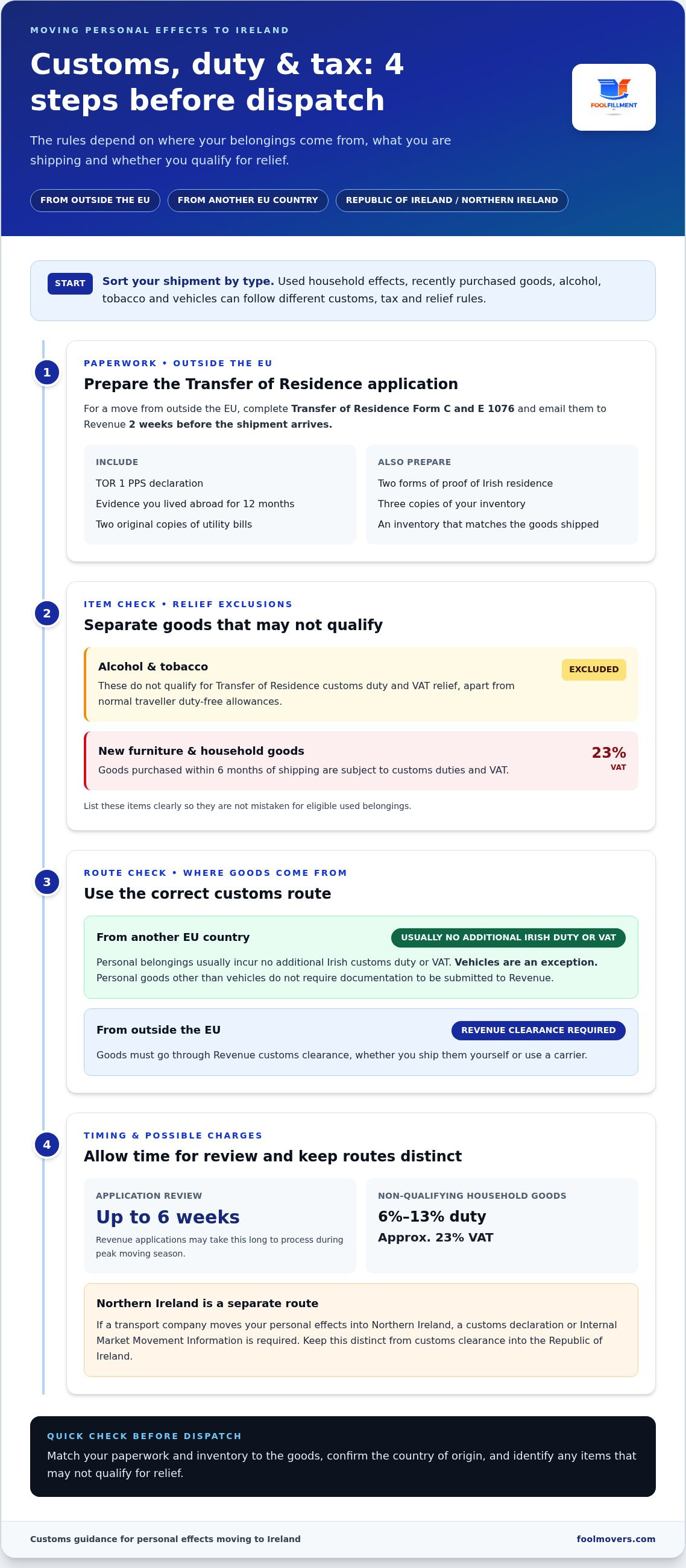
Moving personal effects to Ireland can involve different customs steps depending on where your belongings are coming from. Use these steps to organise the paperwork, relief claim and clearance route before dispatch.
-
Gather Transfer of Residence Paperwork
For a move from outside the EU, complete Transfer of Residence Form C and E 1076, then email them to Revenue 2 weeks before the shipment arrives. Include the TOR 1 PPS declaration and evidence that you lived abroad for 12 months. Prepare two original copies of utility bills, two forms of proof of Irish residence and three copies of your inventory. Make sure the inventory matches the goods being shipped.
-
Check Goods Excluded from Relief
Separate excluded items before preparing the customs paperwork. Alcohol and tobacco don’t qualify for Transfer of Residence Customs Duty and VAT relief, apart from normal traveller duty-free allowances. Eligibility for relief may depend on the nature and use of the goods. New furniture and household goods purchased within 6 months of shipping are subject to customs duties and VAT of 23%. List these items clearly so they aren’t mistaken for eligible used belongings.
- Identify where the shipment is coming from. Personal belongings sent from another EU country to Ireland usually incur no additional Irish VAT or customs duty, although vehicles are an exception. Personal goods other than vehicles don’t require documentation to be submitted to Revenue. Goods arriving from outside the EU must go through Revenue customs clearance, whether you ship them yourself or use a carrier.
- Allow time for application review. Revenue applications may take up to 6 weeks to process during peak moving season. Non-qualifying household goods may incur customs duty of 6% to 13% and VAT of approximately 23%. If moving personal effects to Ireland by transport company into Northern Ireland, a customs declaration or Internal Market Movement Information is required. Keep that route distinct from customs clearance into the Republic of Ireland.
Transit rules for goods destined for another EU State
From the Netherlands, personal belongings usually enter Ireland without additional Irish customs duty or VAT, except for vehicles. If Ireland is a transit point, present the goods to customs in your destination EU Member State and use the transit procedure. Some goods are prohibited or restricted, and vehicles and pets have separate requirements.
-
Plan Freight Routes to Ireland
Plan the route before dispatch. If you’ll live in another EU Member State, tell the haulier Ireland is a transit point, not your final destination. Present the goods to that Member State’s customs authorities and use the transit procedure. Give the haulier an inventory or packing list, clearly identifying the belongings as personal rather than commercial.
-
Secure Household Goods for Ocean Transit
Pack and label household goods so the inventory matches the shipment. A direct freight-ferry move from the Netherlands to Ireland is estimated at 3-5 days door to door. Keep the packing list accessible during the journey, especially if Ireland is a transfer point. Clear descriptions help separate ordinary household effects from goods needing individual customs attention.
-
Declare Non-Standard Household Goods
List unusual items separately, including vehicles, alcohol, tobacco, plants and medicines. Some goods entering Ireland are prohibited or subject to conditions, and may require a licence, so avoid vague inventory descriptions such as “personal items.” For personal property moved by haulier to Northern Ireland, the carrier must generate a Goods Movement Reference before the goods board the ferry.
-
Check Customs Rules and Restricted Goods
Check restrictions before packing food, alcohol, tobacco, plants or medicines. Ireland may prohibit some goods or require conditions or a licence; alcohol and tobacco don’t qualify for Transfer of Residence relief. Register an imported vehicle within 30 days of arrival, even if Vehicle Registration Tax relief applies. For a dog arriving from the Netherlands, arrange tapeworm treatment 24-120 hours before arrival and check its microchip identification. Rabies vaccination must be given from 12 weeks of age, followed by a 21-day wait before travel.
Eligibility for Transfer of Residence relief
Check your move, residence history and belongings before claiming relief. The rules differ for people moving to the Republic of Ireland and those moving goods into Northern Ireland.
-
Check Transfer of Residence Eligibility
Confirm you’re moving from outside the EU to take up normal residence in the Republic of Ireland. You must have owned the goods for at least 6 months before their intended import date and provide evidence that you lived abroad for 12 months. Your household effects must be for personal use, not commercial purposes. Plan for your own arrival before the shipment, since the owner should reach Ireland first.
-
Check Time Limits for Claiming Relief
Set the shipment date against your move date before booking freight. Eligible belongings can be imported within the 6 months before the move or within 12 months after it. Goods must arrive within 12 months of your arrival in the Republic of Ireland. Keep the import date and arrival date clear in your documentation, so customs can assess the timing of your transfer of residence.
- Keep ownership after arrival. Applicants must intend to retain their personal effects for at least 1 year after arriving in the Republic of Ireland. Don’t include commercial property in the claim: goods imported for commercial reasons aren’t eligible for this relief. Separate business equipment from household belongings before preparing the inventory, so the personal-use claim remains clear during customs clearance.
- Check whether your destination is Northern Ireland. Personal property moved there from another part of the UK may qualify for full relief from duty and other customs charges under Northern Ireland Personal Property Relief. This is separate from Transfer of Residence relief for the Republic of Ireland. Confirm the destination and the goods’ origin before arranging collection, because the applicable relief depends on those details.
Personal effects tax exemptions
Sort belongings by purpose and type before claiming an exemption. Ireland’s relief covers qualifying personal property, but vehicles, wedding gifts and commercial items follow different rules.
- Classify each item by its use. Personal property means goods intended for an individual’s use or household needs. People moving from outside the EU to take up normal residence in Ireland may qualify for Customs Duty and VAT relief on certain used belongings. Council Regulation (EC) No 1186/2009, Article 2, Paragraph 1, Point C gives further examples of eligible personal property. Keep personal effects separate from commercial items, which may incur additional taxes.
- Identify special personal-property categories. Qualifying relief may include bicycles, motorcycles, private cars, trailers, caravans, pleasure craft and private aeroplanes brought by people moving from outside the EU. Wedding trousseaux and wedding presents may qualify when someone moves to Ireland on marrying. Each wedding present may be valued at up to €1,000. Record these items and their values separately from everyday household belongings.
- Treat a vehicle as a separate tax case. Vehicle Registration Tax relief may depend on the owner's prior use of the vehicle before moving. Register it within 30 days of arrival in Ireland, even if VRT relief applies. A vehicle registered with a VRT exemption cannot be sold for 12 months after registration. Customs relief and vehicle registration are separate obligations, so include both in your move plan.
- Match the exemption to your route. Ireland is part of the European Union for customs purposes, and personal belongings arriving from another EU country usually incur no additional Irish customs duty or VAT, except in cases such as vehicles. Qualifying personal goods from outside the EU may be eligible for Transfer of Residence relief from duty and VAT. Alcohol and tobacco are excluded from that relief, apart from normal traveller duty-free allowances.
Fool Movers: Home Removals
For small removals between countries in its service area, Fool Movers offers Home Removals and Furniture & Other Items. Its Motorcycles & Scooters service covers bike moves, while Complete Relocation Solutions can suit relocations involving several needs.
Keep your customs paperwork and inventory organised separately from transport arrangements. Clear descriptions help identify the shipment’s contents, while customs authorities decide whether goods qualify for relief. Organising both sides of the move makes it easier to plan transport alongside the paperwork for your destination.
To learn more about Fool Movers’ removal services, visit Fool Movers’ website.
Make your move plan work from day one
Turn your customs preparation into a practical move plan. Set a timeline for collection, shipment and arrival, and keep your inventory and supporting documents together. This gives you a clear reference if a transport or clearance question comes up. For moving personal effects to Ireland, separate the transport arrangements from the relief decision: transport gets your belongings there, while customs eligibility depends on the rules and your circumstances.
Consider what needs to travel, what should stay behind and whether Ireland is your final destination. If your plans include furniture, household goods or a motorcycle, include those details when arranging transport. Fool Movers handles small home removals, furniture and other items, and motorcycles and scooters, so you can discuss the transport that suits your belongings.
Ready to plan the next step? Contact Fool Movers about your move, and take it from there with a clear plan.
Frequently Asked Questions
How do I know if I qualify for the TOR?
You may qualify if you’re moving from outside the EU to make Ireland your normal residence, and your goods are personal rather than commercial. You must have owned them for at least 6 months before import and provide evidence of 12 months’ residence abroad. Check that your shipment timing also fits the permitted import window. Vehicles, alcohol and tobacco have separate or excluded relief rules.
How much does it cost to ship belongings to Ireland?
Transport costs depend on the origin, destination, shipment size and arrangement. Customs charges are separate from the carrier’s transport charge. Belongings moving from another EU country usually don’t incur additional Irish customs duty or VAT, with exceptions such as vehicles. For shipments from outside the EU, eligibility for Transfer of Residence relief can affect the customs and tax bill.
Should I insure my items?
Consider suitable cover if replacing or repairing your belongings would be difficult. Before booking, make an inventory and note valuable or fragile items, such as a bicycle, artwork or electronics. Read the policy wording for covered events, exclusions, limits and claim requirements. Keep photographs and purchase records where available, and store the policy documents with your move paperwork.
What documents do I need when shipping my items?
Prepare an itemised inventory or packing list, with descriptions that distinguish personal belongings from commercial goods. Give a copy to your haulier before collection. For a move from outside the EU where you’re claiming relief, prepare customs paperwork and evidence supporting your residence and ownership claim. A vehicle shipment may need separate records because vehicle registration and tax rules differ from those for household goods.
Can I claim Transfer of Residence relief when moving to Ireland from the Netherlands?
Generally, no. The described Transfer of Residence relief is for people moving from outside the EU to take up normal residence in Ireland. The Netherlands and Ireland are both EU Member States, so personal belongings shipped between them usually don’t incur additional Irish customs duty or VAT. Vehicles are an exception to this general rule and have separate requirements.
Which documents are required to import household goods into Ireland?
For a Transfer of Residence claim, prepare the relevant forms, including Form C and E 1076 and the TOR 1 PPS declaration. Supporting paperwork includes evidence of residence abroad, two original copies of utility bills, and two forms of proof of Irish residence. Keep an inventory with the shipment. For goods from another EU country, personal items other than vehicles don’t require documents submitted to Revenue.
Disclaimer
Website & Blog Disclaimer
Last updated: September 2026
The information published on Foolmovers.com, including articles, guides, tips, FAQs and other editorial content, is provided for general information and guidance only.
Accuracy of Information
Foolmovers makes reasonable efforts to ensure that the information published on this website is accurate and useful at the time of publication. However, information can change without notice, particularly regarding customs procedures, import and export requirements, transport regulations, documentation, taxes, duties, prices, travel restrictions and local regulations.
We therefore cannot guarantee that all information will always be complete, accurate or current.
No Professional Advice
Information published on Foolmovers.com should not be regarded as legal, tax, financial, customs, immigration or other professional advice.
Every international move is different. Requirements may depend on the countries involved, your personal circumstances, residency status, the goods being transported and current legislation.
For important decisions, you should verify the latest requirements with the appropriate authorities or a suitably qualified professional.
Customs & International Moves
Customs regulations and documentation requirements can change and may be interpreted differently by authorities in different countries.
Although Foolmovers can assist customers with transport documentation and customs procedures where applicable, information provided in our articles does not constitute a guarantee that a shipment will be accepted, cleared or exempt from duties, taxes, inspections or additional charges.
Any customs duties, taxes, government charges or third-party fees remain subject to the applicable authorities and service providers unless expressly agreed otherwise.
Prices & Costs
Any prices, rates, fees or cost estimates mentioned in our articles are provided for general guidance unless explicitly stated otherwise.
Actual transport, storage, customs and related costs may vary according to route, volume, dates, availability, fuel prices, tolls and individual circumstances.
For an accurate moving price, please request a personalised quotation from Foolmovers.
Third-Party Websites
Our articles may contain links to external websites, authorities, businesses or other third-party resources.
These links are provided for convenience and additional information. Foolmovers does not control these websites and cannot accept responsibility for their availability, accuracy, content, security or privacy practices.
The inclusion of an external link does not necessarily mean that Foolmovers endorses the organisation, service or information concerned.
Limitation of Liability
To the extent permitted by applicable law, Foolmovers cannot accept liability for losses, damages, costs, delays or other consequences resulting from reliance solely on information published in our articles, guides or other general website content.
Nothing in this disclaimer excludes or limits liability where doing so would be prohibited by applicable law.
Your Individual Move
Information found in one of our articles may not apply exactly to your situation.
If you're planning a European move, contact Foolmovers directly. We can look at your specific route, volume, dates and requirements and provide information relevant to your move.
Foolmovers
Small European Moves, Done Right.


