

You don't need a massive, overpriced moving truck to get your grandmother's Louis XIV cabinet safely across the border. Most people assume that high-end logistics require a museum-grade budget and a mountain of confusing paperwork. It's stressful to worry about scratches, hidden fees, or a driver who doesn't speak a word of French. You're right to be cautious. Your valuables deserve more than being tossed into the back of a generic delivery van.
This guide shows you how to handle transport antiek naar frankrijk without the typical headache. We'll focus on a smarter, small-scale approach that prioritizes safety and clear, kilometer-based pricing. You don't have to overpay for unused truck space just to ensure your items arrive in one piece. We'll walk you through the latest 2026 customs rules, including the 5.5% VAT rate for antiques and essential CITES permits for protected materials. You'll learn how to secure a reliable driver who actually helps with the heavy lifting and speaks the language. Let's get your collection to France safely, affordably, and without the nonsense.
Key Takeaways
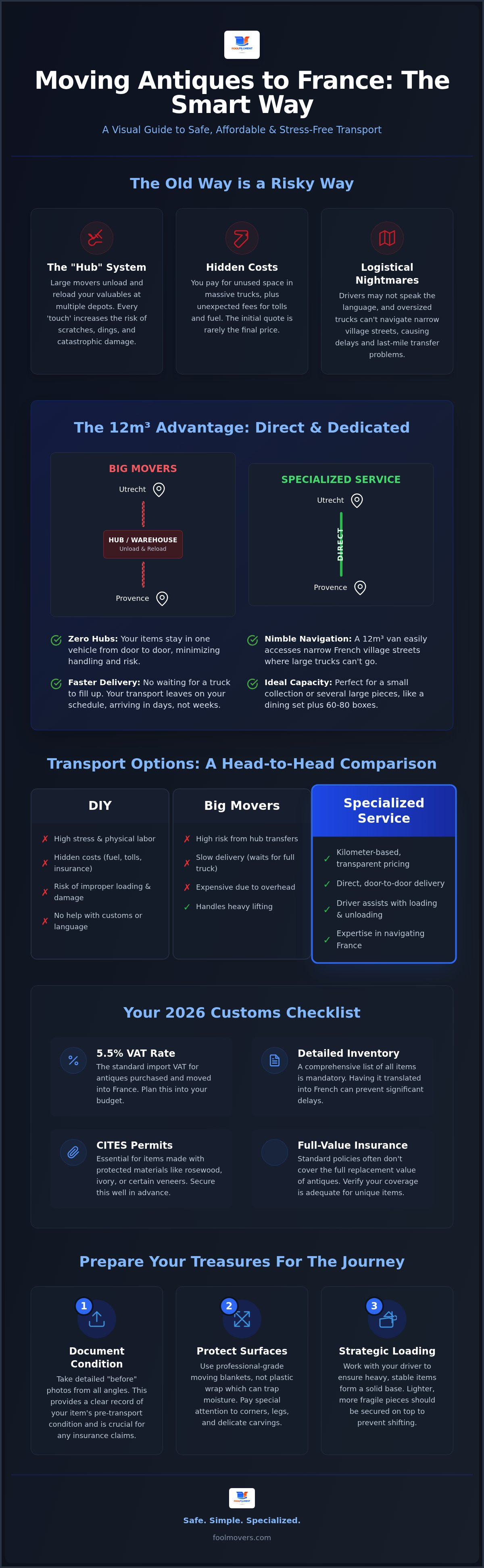
- Learn why a 12m³ van is the "Goldilocks" size for fragile items, ensuring your antiques stay in one vehicle from door to door.
- Discover how to manage transport antiek naar frankrijk efficiently with a driver who handles the heavy lifting and navigates French logistics for you.
- Compare the real costs of DIY versus professional transport to see how kilometer-based pricing saves you money on tolls and fuel.
- Get a checklist for the latest 2026 customs requirements, including specific VAT rates and mandatory permits for protected materials like rosewood.
- Master the art of "before" documentation and surface protection to keep your furniture’s patina safe during the long drive south.
What is Specialized Antique Transport to France?
Specialized antique transport isn't just about renting a van and driving south. It's a focused service designed to move high-value, fragile furniture across borders with zero drama. The route between the Netherlands and France is a famous corridor for collectors and dealers. Whether it's a Dutch marquetry chest or a French farmhouse table, these items require a specific touch. Standard freight companies often treat antiques like any other pallet of goods. That's a mistake. Specialized transport means your items stay in one dedicated vehicle from your front door in Utrecht to your new home in Provence.
A traditional moving company might put your 18th-century cabinet in a massive 40-ton truck alongside ten other households. This involves "hubs" where items are unloaded and reloaded multiple times. Every time someone touches your antique, the risk of a scratch or a broken leg doubles. This is why our approach focuses on direct delivery. A 12m³ van is the sweet spot for this type of work. It's large enough for significant pieces but small enough to navigate narrow French village streets where big trucks get stuck. This is the most reliable way to handle transport antiek naar frankrijk without the typical stress of large-scale logistics.
Why Antiques Require Different Logistics
Old wood is a living material. It has survived centuries, but it's often brittle. The structural integrity of a 200-year-old chair isn't the same as a modern furniture piece. Humidity is another silent killer. Moving from the damp Dutch climate to the dry heat of Southern France can cause wood to warp or crack if the transition is too abrupt. By using a dedicated van, we maintain a more stable environment. We also minimize touchpoints. Our drivers don't just drive; they help secure every item with professional-grade blankets and straps to ensure nothing shifts during the long journey.
The Legal Side: Moving Items within the EU
Moving within the EU is simpler than dealing with the UK or Switzerland, but it isn't a free-for-all. For personal relocations, you can often move your belongings tax-free if you've owned them for at least six months. However, if you're buying an antique to ship to France, the import VAT rate is 5.5% as of 2026. You need a detailed inventory, preferably in French, to avoid transit delays. Standard insurance often has low limits that won't cover a rare heirloom. Always check if your policy covers the full replacement value of unique collectibles. Being prepared means your transport stays on schedule and your budget stays intact.
The 12m³ Advantage: Why Small Loads are Better for Antiques
Most people think bigger is better when moving across borders. For antiques, it's the opposite. A massive moving truck is a liability when you're dealing with a single heirloom or a small collection of delicate furniture. We call the 12m³ van the "Goldilocks" size. It's large enough to fit a complete dining room set or a massive oak armoire, yet nimble enough to deliver directly to your door. Choosing the right vehicle is the first step in successful transport antiek naar frankrijk, and it starts by avoiding the "hub" system.
Standard freight companies and large movers often use warehouses or transfer hubs. Your items get loaded in the Netherlands, unloaded at a depot, and then reloaded onto another truck for the final leg in France. Every time an antique is moved, the risk of damage skydives. With a 12m³ van, there are no hubs. Your items stay in the same spot from the moment they're loaded until they reach their destination. Plus, small vans can navigate the narrow, winding streets of French villages where a 40-ton semi-trailer would simply get stuck. You get door-to-door service without the logistical nightmare of a "last-mile" transfer.
Maximizing Your 12m³ Space
It's easy to underestimate what 12m³ actually looks like. If you're struggling to visualize the volume, our guide on home removals shows exactly what fits inside. Generally, this space accommodates about 60 to 80 standard boxes, or a mix of several large furniture pieces and smaller collectibles. The trick is strategic loading. We place heavy, stable items like solid wood tables at the bottom. Fragile items, like glass-front cabinets or mirrors, are secured on top or along the sides with professional padding. Our drivers act as Tetris masters. They don't just drive; they help you pack the space tightly to prevent any shifting during the 1,000-kilometer journey south.
Speed and Flexibility
Large moving companies wait until their trucks are full before they hit the road. This can leave you waiting weeks for a delivery slot. Small-scale transport is different. We work on your schedule, not a corporate logistics calendar. Because we focus on direct routes, your transport antiek naar frankrijk happens in one go. There are no five-day detours to pick up other customers' sofas. Communication is also easier. Our drivers are multilingual, which is a lifesaver when navigating French toll roads (péage) or talking to a French seller who doesn't speak English. If you're unsure if your collection fits in a single load, send us a quick message with a few photos of your items for a fast assessment.
Comparing Moving Methods: DIY vs. Big Movers vs. Man with a Van
Choosing how to handle transport antiek naar frankrijk usually comes down to three choices. You can do it yourself, hire a massive international moving company, or use a specialized small-scale mover. Each path has its own set of risks and hidden costs. Large movers often rely on "groupage." This means your 18th-century clock sits in a massive trailer next to someone else's lawnmower and greasy bicycle. It's a high-volume game where individual care is secondary. If you want to avoid the "black box" of big logistics, you need to look at the numbers and the handling process closely.
The risk of "unloading errors" is highest with big companies. They use hubs to transfer goods between trucks. Every time your antique is moved, the chance of a structural crack or a lost component increases. DIY seems like the safest way to keep control, but it often ends in exhaustion and broken glass. Our model sits in the middle. We provide a dedicated 12m³ van and a driver who actually helps. This ensures your items stay in one vehicle from start to finish, which is the most effective way to minimize damage during the long haul to France.
The True Cost of DIY
Renting a van for a 1,000km trip sounds budget-friendly until you see the final bill. Fuel for a loaded van is expensive. Then there are the French tolls (péage), which can easily add over €100 to a one-way trip. Driving a large, unfamiliar vehicle through narrow French mountain roads is also incredibly stressful. Most "rookie" packers don't realize that antiques require different bracing than modern IKEA furniture. Without professional-grade straps and the right tension, a heavy wardrobe can shift during a sharp turn in the Alps. By the time you factor in the rental return fees and your own time, the "cheap" DIY option often costs more than professional help.
Transparency in Pricing
Most moving companies hide their margins behind a flat quote. They guess the high end of the cost to protect themselves. We believe per-kilometer billing is fairer because it's based on reality, not a "just in case" estimate. Our pricing starts from €0.80 per kilometer, which includes the van, the fuel, and a driver who handles the loading. There are no hidden surcharges for "international processing" or "admin fees." Distance-based pricing ensures you only pay for the actual road traveled; you never subsidize the empty space of a larger truck or the overhead of a massive logistics office. This transparency makes transport antiek naar frankrijk predictable and affordable for small-to-medium loads.
Preparing Your Antiques for the Long Drive to France
Preparation is the stage where most people get lucky or get hit with a repair bill. You've already decided to skip the high-risk "hub" systems of big movers. Now you need to protect the physical patina of your collection. Successful transport antiek naar frankrijk starts with a camera. Take high-resolution photos of every item from multiple angles before the van arrives. These aren't for your portfolio; they are your primary evidence for insurance if a dispute arises. Document existing scratches, loose joints, or fading. Once you have your baseline, you can focus on the physical shield.
Surface protection is about more than just padding. Never apply adhesive tape directly to antique wood or veneers. The chemicals in the glue can strip away centuries of wax or French polish in seconds. Use professional moving blankets first, then secure those blankets with stretch wrap or tape. For items with drawers or doors, remove the keys and pack them separately. If the locks don't work, use a layer of padding and stretch wrap to keep them from swinging open during a sharp turn in the French countryside. Labeling is your final step. Don't just write "Fragile." Write the specific room in French, such as "Salon" or "Chambre," to help your driver place the item correctly upon arrival.
The Packing Checklist
Choosing between bubble wrap and moving blankets is a common debate. For 18th-century wood, blankets are the winner. Wood needs to breathe. Plastic bubble wrap can trap moisture or heat, which leads to warping or "sweating" on the finish during a long drive. Reserve the bubble wrap for glass panels or porcelain. Corner protectors are your best friend here. Most damage happens when a piece is tilted or set down too hard on its edge. Simple foam or cardboard corner guards prevent 90% of structural chips. Crating is only necessary for the "delicate giants," such as marble-top consoles or massive mirrors. If an item can't support its own weight when tilted, it needs a wooden frame.
On the Day of the Move
When the van pulls up, your job is to clear the path. Ensure there's a wide, trip-free route from the house to the loading ramp. Your driver is there to help with the heavy lifting, but they need space to maneuver. Before the van door closes, do a final stability check. Touch each piece to ensure it doesn't wobble. If you're sending items to a rural French farmhouse, don't rely on a standard street address. French rural numbering is notoriously inconsistent. Provide your driver with exact coordinates or a What3Words location to avoid unnecessary circling on narrow backroads. If you're still unsure about the best way to wrap a specific heirloom, get in touch with our team for expert advice on your specific inventory.
Why Fool Movers is Your Best Partner for France Transport
You aren't just another tracking number in a massive logistics database. Most international moving companies treat antiques like any other pallet of consumer goods. That approach doesn't work for a delicate 19th-century mirror or a hand-carved oak table. We built our service around the "human element." When you choose us for transport antiek naar frankrijk, you get a dedicated partner who understands the value of your collection. Our team is small, our communication is direct, and our focus is entirely on getting your items across the border without a single scratch.
The biggest difference is our drivers. They aren't just steering a van; they're professional handlers who know how to secure fragile loads. They understand how to use tension straps without crushing old wood and where to place padding to prevent vibration damage. Because we specialize in small-scale transport, we don't have the high overhead or the "minimum volume" requirements of the big players. You get the expertise of a high-end art mover with the nuchter, no-nonsense attitude of a local partner. We keep things simple so you can focus on your move.
Our Experience with the France Route
We know the French road network inside out. From the busy peripherique around Paris to the winding, unnumbered backroads of the Dordogne, we've driven it all. This experience matters because French logistics have their own set of quirks. We know which toll systems (péage) are the most efficient and how to navigate restricted "ZCR" zones in French cities. Our multilingual customer service is a major advantage here. We speak Dutch and French fluently. If there's a delay at a border point or a problem finding a rural address, we solve it in the local language. You don't have to worry about language barriers or misunderstood directions. Plus, our "Driver Helps" promise means we're right there with you, assisting with the loading and unloading process to ensure everything is handled with care.
Getting a Quote in Seconds
We don't believe in "black box" pricing. You shouldn't have to wait three days for a vague PDF quote that might change later. Our model is based on a transparent kilometer rate starting from €0.80. This makes it easy to estimate your costs based on the actual distance from the Netherlands to your French destination. Because we use 12m³ vans, we have much better availability than companies running massive rigs. We can often fit into tighter schedules and offer more flexible pickup windows. It's a faster, leaner, and more reliable way to manage your transport antiek naar frankrijk. Ready to get moving? Get your antique transport quote to France now!
Move Your Collection to France Without the Drama
Your antiques are more than just furniture; they're pieces of history that deserve a safe passage. By choosing a dedicated 12m³ van, you skip the high-risk hub systems and ensure your items stay in the same vehicle from door to door. You've learned that smart preparation and direct communication are your best defenses against damage. With our transparent pricing starting from €0.80 per kilometer, you finally have a way to manage transport antiek naar frankrijk without the "black box" quotes or hidden fees of traditional moving companies.
We're here to handle the tolls, the narrow village streets, and the French language barriers for you. Our drivers provide hands-on assistance with every load, making sure your heavy wardrobes and delicate mirrors are positioned perfectly. It's about making international logistics feel like a conversation with a trusted partner instead of a corporate headache. Let's get your valuables to their new home safely and without the nonsense.
Book your safe and affordable antique transport to France today!
Frequently Asked Questions
How much does it cost to transport antiques to France per kilometer?
Our pricing starts from €0.80 per kilometer. This transparent rate covers the 12m³ van, fuel, and a driver who assists with the physical work. We don't use "black box" quotes or hidden surcharges. You only pay for the actual distance between your pickup in the Netherlands and your final French destination. It's a simple model that makes budgeting for transport antiek naar frankrijk predictable and fair.
Is my antique furniture insured during the move to France?
Yes, your items are covered by standard transport insurance during the journey. While this provides peace of mind for most moves, we always recommend checking if your specific high-value heirlooms require additional coverage. For rare collectibles or museum-grade pieces, you should verify the policy limits with us before the trip. We prioritize safety and careful handling to ensure you never have to use that insurance in the first place.
Do I need to pack the antiques myself or does the driver help?
You handle the initial wrapping, but our driver is there to help with the heavy lifting and strategic loading. We don't just park at the curb and wait. Our "Driver Helps" promise means you have a partner to help carry items to the van and secure them safely inside. This assistance is included in our kilometer-based pricing, saving you from hiring extra labor for the loading process.
What is the maximum volume I can transport to France with Fool Movers?
The maximum load capacity is 12m³. This volume is perfect for moving several large furniture pieces, like wardrobes and dining tables, along with dozens of boxes. Because we specialize in small-scale international transport, we don't offer massive 40-ton trucks. This focus allows us to provide a more personalized, direct service that larger moving companies can't match for smaller, high-value loads.
Are there customs duties when moving antiques from the Netherlands to France?
There are no customs duties for moving personal belongings between EU member states. If you're relocating or moving items you've owned for over six months, the process is straightforward. However, if you are buying an antique in the Netherlands to ship to France, a 5.5% VAT rate applies as of 2026. Always keep your proof of ownership and a detailed inventory list ready to avoid any transit questions.
Can you deliver antiques to remote rural areas in France?
Yes, our 12m³ vans are specifically chosen for their ability to reach remote locations. Large moving trucks often get stuck on narrow French country lanes or in historic village centers with height restrictions. Our smaller vehicles provide door-to-door service to any French coordinate, from the peaks of the Alps to secluded farmhouses in the Dordogne. We navigate the "last mile" where the big rigs fail.
How do I prepare a fragile antique for a 1,000km journey?
Protect the surface with moving blankets and secure any loose drawers or glass doors. Avoid using adhesive tape directly on old wood patinas, as it can cause permanent damage. Instead, wrap the item in blankets and use stretch wrap to hold everything in place. Taking "before" photos is essential for your records. Proper preparation ensures your transport antiek naar frankrijk is successful and your furniture arrives in its original condition.
How long does the transport from the Netherlands to France typically take?
Most deliveries are completed within 1 to 3 days. Because we offer direct transport without stopping at distribution hubs or warehouses, your items stay on the move. We drive from your door in the Netherlands straight to your destination in France. This direct route is much faster than traditional moving companies that might take weeks to fill a large truck before starting the journey.


