


A low quote does not always show the full cost of a move. For an international move from the Netherlands, the total may depend on the transport quote, currency conversion, delivery access, customs duties and taxes. Avoiding hidden fees in international moves starts with understanding what the quote includes and what may be charged separately.
It is reasonable to want a clear figure before your belongings set off. To avoid hidden fees in international moves, look beyond the transport charge: exchange rates can affect what you pay, delivery access can affect the work involved, and customs charges depend on your destination and shipment.
This guide explains how these costs work and what to look for in a quote. Learn how to compare fixed and percentage-based fees, identify possible delivery extras, and understand why duties and taxes vary. These checks make it easier to plan for costs before you book.
Key Takeaways
- Compare the exchange rate and all transfer charges, not just the advertised fee, to see the true amount you’ll pay.
- Share delivery access details early, including parking limits and building restrictions, so possible handling charges are easier to spot.
- Compare fixed fees with percentage-based charges against the same service and shipment details.
- Check how customs duties and taxes depend on the destination and your belongings, and use a detailed inventory to clarify the likely costs.
1. Currency exchange fluctuations
Currency conversion can change your total when a quote or payment uses a foreign currency. The exchange rate may include a markup, which means you receive a rate below the mid-market rate. Compare the offered rate with a current mid-market rate, then calculate the amount payable in your currency. Consider the final amount after all charges, not just the advertised transfer fee.
For context, the global average total cost of sending $200 internationally was 6.36% of the transfer amount in Q3 2025, according to the World Bank. The United Nations Sustainable Development Goal target for remittance costs is 3%. These figures concern money transfers, not the price of a move, but they show why exchange costs deserve attention. A small rate difference can matter more as the amount converted grows.
Ask for an itemized international moving quote that separates transport, packing materials, customs clearance, port fees, delivery charges, and insurance options. It should also state the quote currency and explain how exchange-rate changes between quoting and payment affect the amount due. That makes it easier to distinguish the moving service price from currency conversion costs.
To assess a mover’s credentials, compare the legal business name on the quote, contract and invoice. Review any stated insurance documents and coverage, and consider documented customer feedback and references. A polished quote alone is not proof of credentials.
Before booking, read any insurance terms for exclusions, deductibles, coverage limits and the claims process. Check how fragile, valuable or owner-packed belongings are treated, and note any evidence requirements or reporting deadlines. Compare the coverage offered with your inventory, rather than relying on the premium alone.
Use a simple three-step check: compare the quote currency with your payment currency, identify any exchange markup, and calculate the final amount payable. For furniture or other items, make sure the inventory and insurance description match the belongings being moved. That helps you spot gaps before confirming the booking.
2. Delivery access and shuttle charges
A delivery estimate may change if the vehicle cannot reach the property. Narrow streets, restricted parking, pedestrian-only areas or building rules can require extra handling. If belongings need to be transferred from a suitable stopping point, ask whether the quote includes the extra vehicle, labour or time.
Share practical access details before your quote is prepared. Describe the street, parking options, entrance, stairs, lift access and any building restrictions. For example, mention if the vehicle must stop around the corner or furniture must pass through a shared entrance. This helps the provider plan for the actual delivery conditions.
Ask the quote to explain whether shuttle charges apply and how they are calculated. Check whether delivery includes the property entrance or carrying items inside. Clarify whether waiting time, extra handling or a second transfer could change the charge. A clear explanation helps distinguish standard delivery from access-related extras.
In an apartment building, parking and house rules may affect where the vehicle can stop and how belongings reach your home. Share any instructions from the building manager, including delivery hours or entry procedures. If the destination is still being prepared, note known restrictions and update the moving details if they change.
Before booking, compare quotes using the same destination and access details. Check the delivery point, shuttle arrangements and conditions that could change the final charge. Include items such as a sofa or wardrobe that may need special handling through a tight entrance. An accurate inventory helps the provider plan and reduces avoidable surprises.
3. Fixed versus percentage-based fees
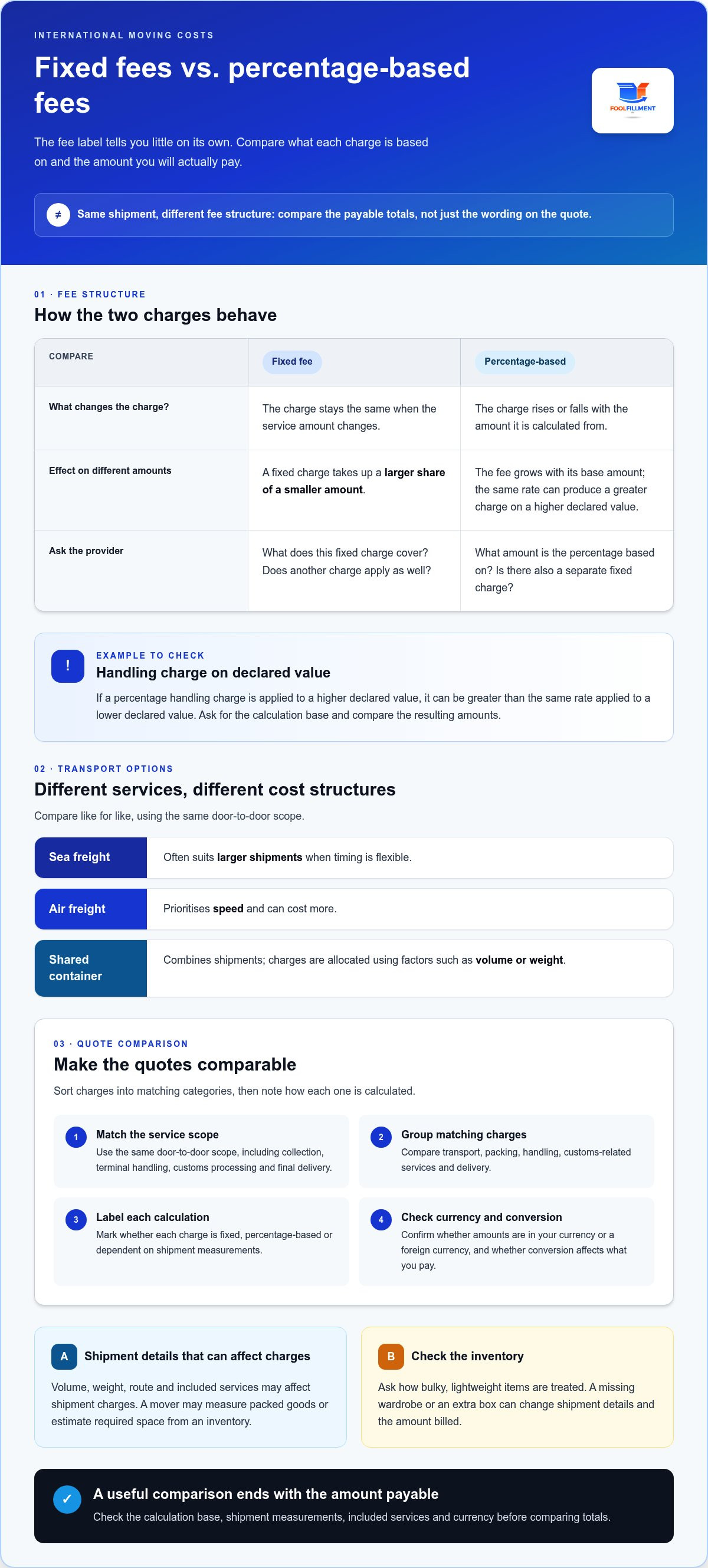
An upfront fee may be fixed, percentage-based or a combination of both. A fixed charge takes up a larger share of a smaller amount, while a percentage charge grows with the amount it applies to. The same shipment can therefore have different totals depending on the fee structure. Compare the amounts payable, not just labels such as “handling” or “processing.”
Sea freight, air freight and shared-container transport have different cost structures. Sea freight often suits larger shipments with flexible timing, while air freight prioritises speed and can cost more. Shared-container transport combines shipments, with charges allocated according to factors such as volume or weight. Compare the same door-to-door scope, including collection, terminal handling, customs processing and final delivery.
Shipment charges may depend on volume, weight, route and included services. A mover may measure packed goods or estimate the space needed from an inventory. Ask what determines the charge and how bulky, lightweight items are treated, then check the inventory against the quote. A missing wardrobe or extra box can change the shipment details and the amount billed.
Check how each fee is calculated. A fixed administration fee stays the same when the service amount changes, while a percentage fee rises with its base amount. For example, a percentage handling charge applied to a higher declared value can be greater than the same rate applied to a lower value. Ask what amount the percentage is based on and whether a separate fixed charge applies.
For a clear comparison, group each quote’s charges into matching categories: transport, packing, handling, customs-related services and delivery. Mark each charge as fixed, percentage-based or dependent on shipment measurements. Check whether the amount is in your currency or a foreign currency, and whether conversion affects what you pay. This review can reveal costs that are easy to miss before you accept an offer.
4. Customs duties and taxes
Customs costs depend on the destination country and the contents of your shipment. Household goods and personal items may be treated differently from vehicles, alcohol or luxury items, which can be costly to import. A detailed inventory helps identify what is being moved and supports a clearer estimate of possible duties and taxes.
For a move to the Netherlands, duty-free eligibility depends on the applicable rules and your circumstances. People returning to a country or moving there on a work visa may qualify for duty-free allowances in some countries. Prepare a complete inventory of household goods and organise records related to your move and shipment. Destination rules determine which documents are required.
Customs duties and taxes are separate from port handling and customs-clearance charges. A quote should show whether port fees, clearance, storage and final delivery are included or billed separately. Actual amounts depend on the shipment, handling needs, destination and any storage period. Ask for each charge to be listed separately, with its calculation basis and payment timing.
If your new home is not ready when your belongings arrive, temporary storage can add costs. A customs delay may also keep a shipment in storage longer. Plan delivery around your move-in arrangements and check how the quote handles storage if the timing changes. If a charge is billed in foreign currency, compare the amount due in your local currency too.
Prepare by listing every item, identifying goods that may need special customs treatment, and comparing the quote’s included services with its exclusions. Do not assume a duty-free allowance means every item enters without charges. Eligibility depends on the destination country’s rules and your shipment details. A clear inventory and separate fee lines make potential costs easier to understand.
Prepare a complete inventory of your household goods and organise records related to your move and shipment. The required documents depend on destination rules and your circumstances.
Fool Movers: Home Removals
Fool Movers can help with Home Removals when you’re planning a move and want to understand the costs involved. Its Furniture & Other Items service suits shipments focused on specific belongings, while Complete Relocation Solutions can support a broader move. Share your inventory, destination, delivery access details, and timing so the moving plan reflects the practical requirements of your shipment.
A clear inventory and accurate delivery information also make it easier to discuss customs steps, access needs and charges in advance. This is useful whether you are moving household belongings or arranging transport for individual items. Review the proposed services and costs together before deciding what suits your move.
For information about your move, visit Fool Movers.
Make your next move with a clear plan
Before dates, addresses or plans change, put your moving priorities in one place. Note what must arrive first, which belongings need special attention, and who will handle key decisions at each end. For urgent paperwork or essential items that cannot wait for bulk freight, dedicated providers like Salus Securities & Courier Services (SS Courier) can ensure swift, direct transport. This gives you a practical reference if the shipment plan changes and helps everyone work from the same information.
Avoiding hidden fees in international moves is easier when you record decisions early and update them as plans develop. Use your move details to start a focused conversation about the arrangements that matter to you. You do not need every detail solved today. A clear first step can make the rest more manageable.
Contact Fool Movers to discuss your move, and take the next step with confidence.
Frequently Asked Questions
What hidden fees are common in international moving quotes?
Common additions include currency conversion markups, port or terminal handling, customs-clearance services, temporary storage, special crating, and delivery charges. Insurance options may also affect the total. Look at the invoice beside your original quote and identify each added line: note what service it covers, how it is calculated, and whether it was triggered by a change to your shipment or delivery plan.
What customs duties, VAT, and import taxes apply when moving household goods to the Netherlands?
There is no single blanket charge for every household move to the Netherlands. The applicable treatment depends on the shipment, its origin, the goods and your circumstances. Household belongings may qualify for duty-free treatment under some countries’ rules, but do not assume every item is exempt. Prepare an itemised inventory and establish which duties, VAT or import taxes apply to your goods before arranging payment.
What extra charges can apply for stairs, long carries, shuttle trucks, or difficult access?
Extra handling or shuttle charges may arise if a vehicle cannot reach the building, parking is restricted or belongings need to be carried farther. Stairs, a narrow entrance or building delivery rules can also affect the work involved. Tell the mover if a large item must be carried from a distant parking point, and share access instructions before the delivery plan is finalised.
What steps can I take to avoid surprise charges before and during an international move?
Start with a complete inventory and accurate origin, destination and access details. Compare quotes for the same shipment and delivery scope, then keep the written terms and itemised charges. During the move, promptly report changes such as extra belongings, a new delivery address or delayed access. Keep updated documents and invoices together so you can match any new charge to the change that caused it.
Disclaimer
Website & Blog Disclaimer
Last updated: September 2026
The information published on Foolmovers.com, including articles, guides, tips, FAQs and other editorial content, is provided for general information and guidance only.
Accuracy of Information
Foolmovers makes reasonable efforts to ensure that the information published on this website is accurate and useful at the time of publication. However, information can change without notice, particularly regarding customs procedures, import and export requirements, transport regulations, documentation, taxes, duties, prices, travel restrictions and local regulations.
We therefore cannot guarantee that all information will always be complete, accurate or current.
No Professional Advice
Information published on Foolmovers.com should not be regarded as legal, tax, financial, customs, immigration or other professional advice.
Every international move is different. Requirements may depend on the countries involved, your personal circumstances, residency status, the goods being transported and current legislation.
For important decisions, you should verify the latest requirements with the appropriate authorities or a suitably qualified professional.
Customs & International Moves
Customs regulations and documentation requirements can change and may be interpreted differently by authorities in different countries.
Although Foolmovers can assist customers with transport documentation and customs procedures where applicable, information provided in our articles does not constitute a guarantee that a shipment will be accepted, cleared or exempt from duties, taxes, inspections or additional charges.
Any customs duties, taxes, government charges or third-party fees remain subject to the applicable authorities and service providers unless expressly agreed otherwise.
Prices & Costs
Any prices, rates, fees or cost estimates mentioned in our articles are provided for general guidance unless explicitly stated otherwise.
Actual transport, storage, customs and related costs may vary according to route, volume, dates, availability, fuel prices, tolls and individual circumstances.
For an accurate moving price, please request a personalised quotation from Foolmovers.
Third-Party Websites
Our articles may contain links to external websites, authorities, businesses or other third-party resources.
These links are provided for convenience and additional information. Foolmovers does not control these websites and cannot accept responsibility for their availability, accuracy, content, security or privacy practices.
The inclusion of an external link does not necessarily mean that Foolmovers endorses the organisation, service or information concerned.
Limitation of Liability
To the extent permitted by applicable law, Foolmovers cannot accept liability for losses, damages, costs, delays or other consequences resulting from reliance solely on information published in our articles, guides or other general website content.
Nothing in this disclaimer excludes or limits liability where doing so would be prohibited by applicable law.
Your Individual Move
Information found in one of our articles may not apply exactly to your situation.
If you're planning a European move, contact Foolmovers directly. We can look at your specific route, volume, dates and requirements and provide information relevant to your move.
Foolmovers
Small European Moves, Done Right.


