

Art Shipping Methods: Why a Dedicated Van Beats a Courier
When you need to ship art internationally, your first thought might be a big-name courier. It seems simple: box it up and send it. But the journey your priceless painting or sculpture takes is far from simple. The standard parcel network is a world of automated sorting hubs, high-speed conveyor belts, and multiple transfers—an environment fundamentally hostile to fragile, high-value items.
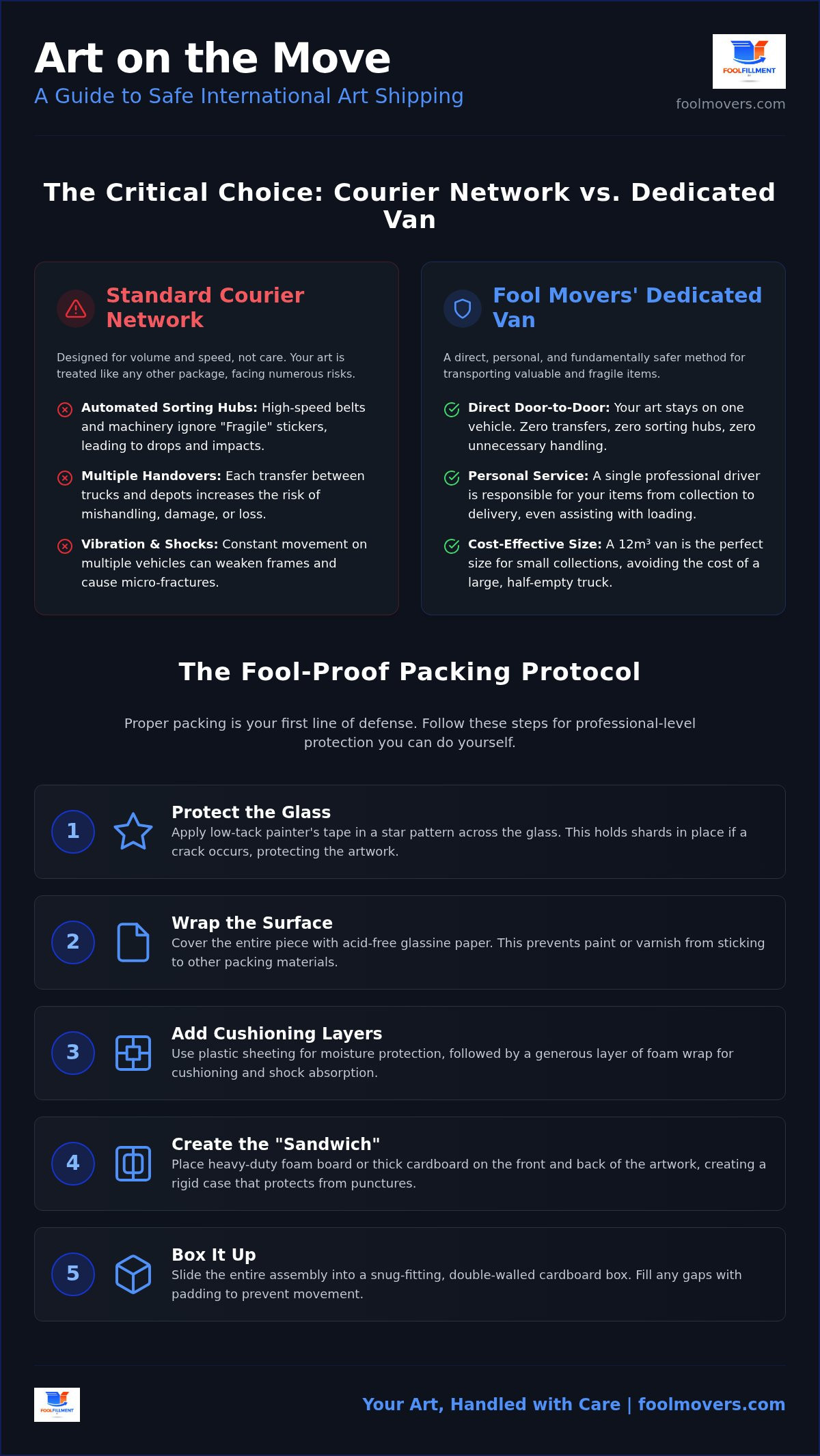
- The "Sorting Hub" Risk: Automated belts don’t read "Fragile" stickers. Your art is treated like any other package, subject to drops, bumps, and vibrations that can damage frames, crack glass, or tear canvas.
- Dedicated Transport: The alternative is a dedicated van. This means one vehicle, one driver, and zero transfers from collection to delivery. Your art is loaded carefully, secured, and remains untouched until it reaches its destination.
- The 12m³ Sweet Spot: You don’t need a massive, half-empty lorry for an art move. A 12m³ van is the perfect size for a small collection, a few large pieces, or a mix of art and other valuable household goods, making it far more cost-effective.
- Driver Assistance: With a dedicated van comes a professional driver who is on-site to help with the careful loading and unloading of your pieces. It’s a personal touch that automated systems can never replicate.
The Problem with Parcel Networks
Parcel courier networks are designed for speed and volume, not for care. The "last mile" of delivery is notoriously rough, but the entire journey is a gauntlet of risks. Every time your package is scanned and moved between trucks, depots, and local vans, the potential for human error or mechanical damage increases exponentially. "Fragile" stickers often become little more than decoration in a facility processing thousands of packages an hour. For something as irreplaceable as art, this model is a high-stakes gamble.
- Vibration & Impact: Constant vibration on multiple trucks and the jarring impacts of automated sorting can weaken frames and cause micro-fractures in paint or sculpture materials.
- Multiple Handovers: Each transfer from one person or vehicle to another is a new opportunity for a drop, a mishandling, or even loss.
- The Reality of "Fragile" Stickers: In a high-speed logistics environment, careful handling is a hope, not a guarantee. Your artwork is just another box in a system built for efficiency, not delicacy.
The Fool Movers Alternative
We built our service to eliminate these risks. By using a dedicated van for every move, we ensure your art is never lost in a massive sorting hub or passed between strangers. It’s a fundamentally safer and more personal way to ship valuable items across Europe.
- Direct Transport: Your art stays exactly where you saw it loaded. No cross-docking, no conveyor belts, no unnecessary handling. Just a direct, door-to-door journey.
- Personalized Service: You know who is handling your valuables. Our driver is your single point of contact, responsible for the safe transit of your collection from start to finish.
- Transparent Kilometer-Based Pricing: You pay for the distance your art travels, not for a special "fine art" label. Our quotes are clear and straightforward, with no hidden fees for the value of your items.
The Fool-Proof Packing Protocol for International Transit
Proper packing is your first line of defense against the bumps and vibrations of an international move. While a dedicated van drastically reduces the major risks, securing your art correctly is non-negotiable. You don't need to be a museum curator to achieve professional-level protection. It just takes the right materials and a methodical approach.
- Surface Protection: Always start with a layer of acid-free glassine paper. This smooth, waxy paper prevents paint, varnish, or finishes from sticking to the wrapping material, which can happen with temperature changes.
- The "Star" Method: For any piece framed with glass, apply low-tack painter's tape in a star or asterisk pattern across the entire surface. If the glass cracks under pressure, the tape will hold the shards in place, preventing them from slicing the canvas or artwork beneath.
- Rigid Enclosures: The goal is to create a "micro-environment" for your art. A sandwich of foam board on both sides, followed by a sturdy cardboard box, protects the piece from punctures and pressure.
- Crating vs. Double-Walling: A custom wooden crate is the ultimate protection but isn't always necessary. For most paintings and smaller sculptures, a well-constructed double-walled cardboard box with proper internal padding offers excellent security, especially within a dedicated van. Crates are best reserved for extremely heavy, valuable, or unusually shaped pieces.
Step-by-Step: Packing a Painting
Follow these steps for a gallery-grade packing job you can do yourself.
- Protect the Glass: If your painting is behind glass, apply low-tack artist tape or painter's tape directly to the glass in a large star pattern, extending from corner to corner and edge to edge. This ensures that if the glass breaks, it won't damage the artwork.
- Wrap the Surface: Cover the entire front of the piece (glass and frame) with a sheet of acid-free glassine paper. This is the only material that should directly touch the surface of your art or its varnish.
- Add Moisture & Cushioning Layers: Wrap the entire piece in a layer of plastic sheeting or a pallet wrap to protect against humidity. Follow this with a generous layer of soft, flexible packing material like foam wrap. Avoid standard plastic bubble wrap as the first cushioning layer, as it can leave impressions on the varnish.
- Create the "Sandwich": Cut two pieces of heavy-duty foam board or very thick cardboard to be slightly larger than the frame. Place one on the front and one on the back, creating a rigid "sandwich." Tape them together securely.
- Box It Up: Slide the entire sandwich into a snug-fitting, double-walled cardboard box. A custom-sized "mirror box" is ideal. Fill any remaining gaps with foam padding or crumpled packing paper to ensure nothing can shift during transit. Seal and label the box clearly.
Securing Sculptures and 3D Art
Packing three-dimensional art requires a different strategy focused on shock absorption and support for fragile points.
- Identify Pressure Points: Before you wrap anything, carefully examine the sculpture. Identify fragile extremities like arms, fingers, or delicate details. These areas will need extra support and cushioning.
- The "Box-in-a-Box" Technique: This method provides maximum shock absorption. First, wrap the sculpture carefully, using foam wrap and extra padding around fragile points. Place it in a sturdy, well-padded box. Then, place that entire box inside a second, larger box, filling the 5-10 cm gap on all sides with packing peanuts, foam, or crumpled paper. This outer layer absorbs the brunt of any impacts.
- Why You Should Never Use Standard Bubble Wrap Directly on Art: The plastic bubbles in standard wrap can trap moisture and heat against the art's surface. Under changing temperatures during transit, this can cause varnish to soften and stick, leaving a permanent polka-dot pattern on your piece. Always use glassine paper as the first layer.
Navigating Customs: UK, Switzerland, and Norway
Shipping art to a non-EU country like the UK, Switzerland, or Norway involves customs clearance. This sounds intimidating, but it's straightforward when you have the right paperwork and approach. The key is understanding that you are typically moving art as part of your personal belongings or "household goods," which often qualifies for tax and duty relief.
- Customs Clearance: When art is part of a personal relocation, it's not treated as a commercial import. This changes the paperwork and can exempt you from paying VAT and import duties.
- Country-Specific Rules: The post-Brexit UK, as well as Switzerland and Norway, have distinct procedures. Knowing what forms are needed beforehand is crucial for a smooth border crossing.
- Valuation for Customs: You must declare a value for your art. This should be an honest "fair market" or insurance value. Being accurate prevents issues with customs and ensures proper coverage if you need to make an insurance claim.
- The Fool Movers Advantage: We handle the customs administration. We know the forms, the procedures, and the common pitfalls. We prepare the necessary declarations so you don't have to become a customs expert overnight.
Shipping Art to the UK Post-Brexit
Moving your art collection to the UK from the EU is now an international move that requires a customs declaration. However, for those relocating their primary residence, significant relief is available.
- Understanding Transfer of Residence (ToR) Relief: If you are moving your home to the UK, you can apply for ToR relief. If granted, this allows you to bring your personal belongings (including your art collection) into the UK without paying VAT or import duties. You must apply for this online *before* your move.
- Required Documentation: You'll need a detailed inventory of the items you're moving, including descriptions and values for your art. Proof of your move (e.g., a rental agreement or job offer) is also required for the ToR application.
- Avoiding Delays: The most common delay at the Eurotunnel or ferry ports is incorrect or incomplete paperwork. With our expertise in moving to England after Brexit, we ensure all documents are correctly filed in advance for a seamless crossing.
Swiss and Norwegian Border Logistics
Switzerland and Norway, while in Europe, are not in the EU customs union, meaning border controls are always in place. The process is well-defined and efficient if you're prepared.
- Handling the "T-form" for Transit: A T-form is a transit document that allows goods to pass through a territory (like Switzerland) without paying import duties, on their way to another destination. We manage these documents for moves that cross non-EU borders.
- Specific Requirements for Antiques: Both countries have specific regulations for antiques. Generally, an item must be over 100 years old (Switzerland) or 50 years old (Norway) to be officially classified as an antique, which can affect its customs treatment. Proper documentation of provenance and age is key.
- How Fool Movers Manages the Process: We manage the entire Customs and Administration process. From preparing the Swiss e-dec or Norwegian TVINN declarations to ensuring the driver has the correct paperwork, we handle the logistics so your move isn't held up at the border. For more on Swiss moves, check our guide to relocating to Switzerland.
Risk Management: Insurance and Safety Checks
Even with the safest transport method, managing risk is essential. This comes down to two things: proper insurance and clear documentation. Taking a few simple steps before your move provides peace of mind and critical protection in the unlikely event that something goes wrong.
- Standard Liability vs. Specialist Art Insurance: A mover's standard liability is often based on weight, which is completely inadequate for valuable art. You need insurance that covers the replacement or restoration value of your specific pieces.
- Pre-Move Documentation: High-resolution "before" photos are your best friend. They provide indisputable proof of an item's condition before it was loaded onto the van.
- Climate Control: While a dedicated van isn't a climate-controlled museum vault, it avoids the extreme temperature fluctuations of an uninsulated shipping container or the cargo hold of a plane. The direct, swift journey minimizes exposure to harsh conditions.
- Inventory Management: A detailed, signed inventory list is crucial, especially for a multi-item move. It ensures every piece is accounted for at both loading and unloading.
Documenting Condition
A condition report is a simple, visual record of your artwork's state before the move. This is your primary evidence for any insurance claim. To create one, you simply need to systematically photograph and note the condition of each piece before it's packed. Focus on capturing details like the corners of frames, the texture of the canvas, existing repairs, and close-ups of signatures or edition numbers. This documentation, paired with a detailed inventory list signed by both you and the driver upon loading, forms your best legal and financial protection.
- How to Photograph: Use good lighting and a high-resolution camera (a modern smartphone is fine). Take a photo of the entire piece, then close-ups of the four corners, the back of the frame, any artist signatures, and any pre-existing imperfections.
- The Signed Inventory: This is a simple list of every item being loaded. At loading, you and the driver review and sign it. At unloading, you check off each item as it comes off the van. It's a simple but powerful tool to prevent loss or disputes.
Insurance Realities
Don't assume you're covered. It's vital to understand the specifics of what your insurance policy includes—and excludes.
- Check Your Home Insurance: Some home and contents insurance policies include "goods in transit" coverage, but it often has limits. Call your provider to confirm if your art is covered for an international move and what the value limits are.
- What to Look for in a Mover’s Insurance: If you opt for insurance through your mover, ask for the policy details. Is it "all-risk" coverage? What is the deductible? Does it cover the full declared value of your art?
- The "Total Loss" vs. "Restoration" Debate: Ensure the policy covers not just total loss but also the cost of restoration. A damaged piece may be repairable, and the insurance should cover the cost of a professional art restorer.
Booking Your Art Transport: The Fool Movers Way
We believe shipping your art should be as transparent and straightforward as the rest of our services. Our process is designed to be simple, with no-nonsense pricing and clear communication from start to finish. It’s built around our core model: providing a dedicated van and driver for your small European move.
- Calculating Your Load: Our service is perfect for loads up to 12m³. This is surprisingly spacious and can accommodate a significant collection of paintings, sculptures, and even some furniture.
- The Booking Process: It starts with a simple, kilometer-based quote. Once you approve, we schedule your dedicated van. We handle the rest, from planning the route to managing customs paperwork.
- Preparing for the Driver: To ensure a smooth loading day, make sure your art is packed and ready to go. Clear a path for the driver and have your inventory list prepared for sign-off.
- Why Fool Movers is the Smart Choice: We combine the safety of a specialist art handler with the affordability and simplicity of a direct removal service. Learn more about why we're the smart choice for European removals.
Assessing Your Volume
Is your collection under the 12m³ limit? It’s easier to visualize than you think. A 12m³ van can typically hold the contents of a studio apartment or around 100 medium-sized moving boxes. This makes it an ideal and cost-effective solution for artists, collectors, and small galleries.
- Visualizing 12m³: Think of a space that is 3.5 meters long, 1.8 meters wide, and 1.9 meters high. This can easily fit several large canvases, numerous boxed paintings, and a few small-to-medium sculptures.
- Combining Art with Other Items: Because we specialize in Home Removals, you can efficiently combine your art collection with other household goods, antiques, or furniture, all in the same dedicated van.
- Why We Focus on Small, Valuable Loads: Our model is built for efficiency and care. By focusing on moves up to 12m³, we ensure every client gets a dedicated van and personalized service, which is perfect for high-value items like art and antiques.
Ready to Move?
Getting your art collection to its new home safely doesn't have to be complicated or outrageously expensive. Our process is designed for clarity and peace of mind.
- Get a Fast, Transparent Quote: Contact us with your collection and destination addresses. We'll provide a clear, all-inclusive quote based on the distance, with no hidden surcharges.
- Multilingual Support: Our team is here to support you in over five languages. We'll keep you informed at every stage of the journey.
- Final Checklist: Before the van arrives, ensure your art is packed, your inventory is printed, your documentation (like a ToR approval number) is ready, and access to your property is clear.
Frequently Asked Questions
Is it safe to ship a painting in a moving van?
Yes, provided it’s a dedicated moving van. The danger lies in co-loading with heavy, unstable items or using a parcel network where the box is handled multiple times. In a dedicated Fool Movers van, your art is secured by a professional and travels directly to its destination, making it one of the safest methods available.
Do I need a wooden crate for every piece of art?
No. A custom wooden crate offers maximum protection but is often overkill for moves within a dedicated van. For most paintings, a well-packed, double-walled cardboard box with internal foam board reinforcement is perfectly adequate and more cost-effective. Crating is best reserved for exceptionally valuable, heavy, or fragile 3D pieces.
What paperwork is required to ship art from the Netherlands to the UK?
Since Brexit, you need a customs declaration. The key document is a detailed inventory list with descriptions and values. If you are moving your home, you should apply for Transfer of Residence (ToR) relief in advance to avoid paying VAT and import duties. Fool Movers prepares and manages the necessary customs filings for you.
How much does it cost to ship art internationally?
The cost varies widely. "White glove" fine art shippers charge a premium for the "art" label. Parcel couriers can be cheaper but carry high damage risks. Fool Movers offers a transparent, kilometer-based price. You pay for the van and the distance, not a percentage of your art's value, making it a fair and predictable option.
Can I ship antiques along with my art collection?
Absolutely. Our 12m³ vans are ideal for mixed loads of valuable items. We frequently transport art, antiques, designer furniture, and other prized possessions together in one dedicated, secure move.
How do I protect the corners of my frames during transit?
You can buy specialized cardboard or foam frame corner protectors online. In a pinch, you can create your own by folding thick cardboard into triangles and taping them securely over each corner before you begin the wrapping process. This is a critical step to prevent dings and chips.
What is glassine paper and why is it used for art?
Glassine is a smooth, glossy, acid-free paper that is air and water-resistant. It's used as the first layer when packing art because it creates a neutral, non-stick barrier. It prevents paint or varnish from adhering to other packing materials if they soften due to temperature changes, and it protects the surface from scratches.
Does Fool Movers help with customs clearance for Switzerland?
Yes. We are experts in handling customs for non-EU countries, including Switzerland. We prepare the necessary transit documents and import/export declarations to ensure your art collection crosses the border without any delays or complications.


