
The Swiss border isn't a wall designed to keep you out. It's just a logic puzzle that requires the right pieces to solve. Most people dread customs clearance for moving to Switzerland because they've heard horror stories about Form 18.44 or being turned away for a single missing signature. You're likely staring at your furniture and wondering if that strict six-month ownership rule is going to cost you a fortune in duties. It's a lot of pressure when you just want to start your new life in the mountains without a legal headache.
We get it. Dealing with Swiss authorities should be a formality, not a fight. This guide simplifies the entire 2026 customs process so you can import your household goods duty-free without the administrative migraine. We'll walk you through the essential document checklist, explain the 8.1% VAT rules, and show you exactly how to prove your belongings are yours. You'll get a clear roadmap to ensure your move is 100% compliant and completely stress-free.
Key Takeaways
- Claim your duty-free status by mastering the "Relocation Goods" requirements and avoiding the 8.1% VAT on your personal belongings.
- Follow our checklist for Form 18.44 to handle your customs clearance for moving to Switzerland without the risk of being turned back at the border.
- Learn how to navigate the mandatory commercial lanes and why digital pre-filing two days before your arrival is the key to a fast crossing.
- See how specialized small-load solutions for moves under 12m³ can save you from the administrative costs of larger, traditional removals.
Understanding Customs Clearance for Moving to Switzerland
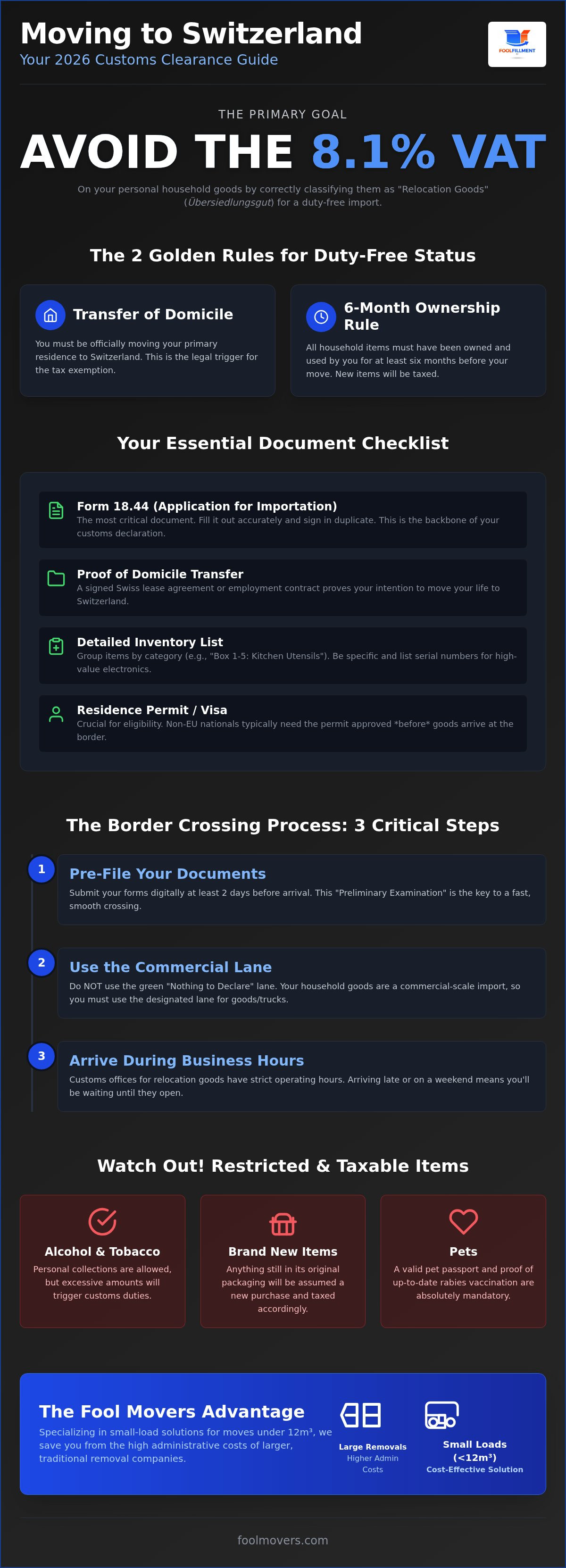
Switzerland sits right in the middle of Europe, but it's not in the EU. This is why customs clearance for moving to Switzerland is a mandatory step for everyone. Every item in your moving van is technically an import. The Swiss Federal Office for Customs and Border Security needs to know exactly what's entering the country. To avoid the standard 8.1% VAT, your belongings must qualify as "Relocation Goods" or Übersiedlungsgut. This category covers everything from your bed to your coffee machine, provided they aren't intended for resale.
The most important hurdle is the six-month rule. You must have owned and used your household items for at least half a year before the move. If you buy a new TV or a luxury sofa just for the move, you'll likely pay tax on it at the border. Transfer of Domicile is the legal trigger for duty-free import, signifying that you're moving your primary residence to Swiss soil. It's the moment your life officially shifts to the Alps, and the paperwork must reflect that shift.
To better understand how this process works, watch this helpful video:
Who is Eligible for Duty-Free Import?
Eligibility depends heavily on your permit status. EU and EFTA citizens generally need a residence permit or a signed lease agreement to prove their move. Non-EU nationals have a steeper climb; you'll need your residence permit approved before your goods arrive at the border. If you're a student, you can often bring your study materials and basic furniture tax-free, but you must prove you're enrolled in a Swiss school. Secondary residences are much trickier. Since you aren't officially transferring your domicile, you won't qualify for the same tax exemptions as a full relocation move. We specialize in these small, personal loads under 12m³, making sure the paperwork matches your specific situation perfectly.
Essential Documents: Mastering Form 18.44
Form 18.44 is the backbone of your relocation. It's the official Application for Importation of Household Effects. Filling it out correctly is the difference between a smooth entry and a long day at the border. You'll need to prove you're moving your life, so your lease agreement or employment contract is your golden ticket. These documents prove your Transfer of Domicile. For a professional look at the Customs Declaration and Border Crossing requirements, legal experts emphasize having your relocation dossier ready before you arrive. Always sign your forms in duplicate and keep the physical copies in the van. Digital versions are helpful, but border agents often want the ink-on-paper reality.
The Detailed Inventory List
Don't list every individual spoon. Group items by category or box number, like "Box 1-5: Kitchen Utensils." However, you must be specific with high-value items. List large appliances like washing machines or high-end electronics with their serial numbers. This transparency reduces the chance of a physical inspection. Agents appreciate a list that's easy to cross-reference with the van's contents. If you're feeling overwhelmed by the paperwork, you can always get in touch with us to help organize your dossier.
Prohibited and Restricted Items
Customs clearance for moving to Switzerland comes with strict limits on alcohol and tobacco. You can bring personal wine collections, but excessive amounts will trigger duties. New furniture is another trap. If it's still in the original box, agents assume it's a new purchase and will tax it. For pets, ensure you have a valid pet passport and proof of rabies vaccination. Switzerland is strict about animal health; check the latest requirements for your specific breed before hitting the road. We handle these small loads every day and know exactly which items raise red flags.
The Logistics: Crossing the Swiss Border in 2026
Don't follow the "Nothing to Declare" green lane. When you're managing customs clearance for moving to Switzerland, you must use the commercial lane. Even if you're just driving a small van with 10m³ of boxes, you're technically transporting a commercial-scale load of personal effects. Arriving at the wrong gate leads to delays and frustrated agents. Timing is everything here. Swiss customs for relocation goods operate on a strict business clock; if the commercial office is closed, your moving van stays parked.
The "Preliminary Examination" is your secret weapon for a fast crossing. By pre-filing your digital dossier at least 48 hours before you reach the border, you allow agents to review your Form 18.44 in advance. This digital head start often means your physical stop is just a quick stamp and a "welcome to Switzerland." If an agent decides on a physical inspection, stay calm. They usually just want to verify that your inventory list matches the boxes in the back. A tidy van and a polite attitude go a long way. To ensure your digital filing is perfect before you hit the road, book a consultation with our customs experts today.
Importing Motor Vehicles
Bringing your car or motorcycle? The six-month ownership rule applies here too. If you've owned the vehicle for less than half a year, expect to pay the full 8.1% VAT plus a 4% automobile tax. You'll need to fill out Form 15.30 for a tax-free import. There's a catch: you cannot sell the vehicle for at least 12 months after importing it. If you do, the Swiss government will come knocking for those waived taxes. We regularly handle motorcycle and car shipments, ensuring all paperwork is filed correctly before we hit the commercial lane.
Small Removals to Switzerland: The Fool Movers Advantage
Most moving sites assume you're shipping a massive 40ft container. If you've only got a small apartment's worth of furniture, that's overkill. We focus exclusively on small loads under 12m³. This specialization allows us to streamline the customs clearance for moving to Switzerland. We don't just drop off a van; we handle the admin fees and the complex paperwork as part of our core service. You won't find yourself lost in a sea of forms or facing unexpected charges at the border.
The real benefit is our driver-assisted approach. Our chauffeurs navigate the commercial lanes every week. They know the border agents and understand the "no-nonsense" way through the checkpoints. Having an expert by your side prevents the administrative headaches that turn a move into a nightmare. You can learn more about our home removals to Switzerland to see how we manage these specific routes.
Transparent Pricing for Cross-Border Moves
Hidden fees are the enemy of a stress-free move. We eliminate them through clear, upfront communication. Our pricing is built on a transparent km-based system for international trips. This means you know exactly what the logistics cost before we even start the engine. We factor in the customs clearance for moving to Switzerland so you aren't hit with "surprise" costs once the van is already in the Alps.
Why Us for Your Swiss Relocation?
Navigating Swiss borders requires more than just a map; it requires a voice. Our team offers multilingual support for Dutch, English, German, and French speakers. Whether we're talking to you or the customs officials, nothing gets lost in translation. This linguistic flexibility is a huge part of why our clients trust us. See why us for your small European move and let us handle the heavy lifting and the red tape.
Start Your Swiss Life Without the Paperwork Stress
Moving to the Alps should be about the view, not the red tape. By now, you know that mastering Form 18.44 and respecting the six-month ownership rule are the secrets to a duty-free entry. You've seen why digital pre-filing and using the commercial lanes are essential for a smooth crossing in 2026. Managing customs clearance for moving to Switzerland doesn't have to be a solo struggle. Whether you're bringing a few rooms of furniture or your favorite motorcycle, the right preparation makes all the difference.
As small load specialists, we handle the complex admin for moves under 12m³ so you don't have to. Our team offers multilingual support and expert knowledge of non-EU customs to ensure your belongings arrive without a hitch. We believe in transparency and a no-nonsense approach to logistics. Ready to cross the border with confidence? Get a transparent quote for your move to Switzerland and let us take care of the heavy lifting. Your new home is waiting, and we're here to help you get there.
Frequently Asked Questions
Do I have to pay VAT on my furniture when moving to Switzerland?
You don't have to pay the standard 8.1% VAT if your belongings qualify as relocation goods. This exemption applies when you're officially transferring your residence and have owned the items for at least six months. If you can't prove this, the Swiss authorities will treat your furniture as a standard import. We ensure your inventory list is structured correctly to claim this tax-free status without border complications.
What is Form 18.44 and where do I get it for my 2026 move?
Form 18.44 is the official declaration for importing household effects duty-free. It's the most critical document for customs clearance for moving to Switzerland. You can download the latest 2026 version directly from the Swiss Federal Office for Customs and Border Security website. Filling it out correctly requires a detailed inventory and proof of your new Swiss residence, such as a lease or an employment contract.
Can I move to Switzerland with a rented van myself?
You can drive a rented van, but it's often more trouble than it's worth. Most rental companies have strict rules about taking vehicles into non-EU countries like Switzerland. You'll still need to navigate the commercial lanes and handle all the 18.44 paperwork yourself. Arriving at the border without the right digital pre-filing can lead to long wait times or being turned away if the commercial office is closed.
What happens if I haven’t owned my furniture for 6 months?
Items owned for less than six months are generally subject to the standard 8.1% Swiss VAT. The customs office views these as new purchases rather than personal effects. You'll need to provide receipts or invoices for these items at the border. It's best to keep these new items separate on your inventory list so the agent can calculate the tax quickly without inspecting every single box in your van.
Does Fool Movers help with the Swiss customs paperwork?
Yes, we handle the heavy lifting when it comes to customs clearance for moving to Switzerland. Our service for small loads under 12m³ includes managing the administrative fees and assisting with the necessary documentation. Our multilingual drivers guide you through the commercial lanes, making sure everything is filed correctly. We take the guesswork out of the process so you can focus on settling in instead of fighting with forms.


