


For a small move, a van can be a better fit than a truck, and moving from Netherlands to UK after Brexit also means planning for border formalities as well as packing and transport.
If you’re unsure which documents to organise, what to arrange before departure, or which transport option suits your belongings, start by separating two questions: your right to enter and live in the UK, and the requirements for bringing household goods across the border. The rules depend on your circumstances, so check current official guidance rather than relying on an old checklist.
This practical 2026 checklist covers what to verify, how to organise your belongings and how van and truck logistics compare for a smaller move. Work through the checks in order, estimate what you’re moving and make transport decisions based on the actual load and access at both addresses.
Key Takeaways
- For moving from Netherlands to UK after Brexit, check current official guidance for your residence status and belongings before setting a moving date.
- Make an itemised inventory and keep personal records and moving correspondence organised.
- Estimate your belongings by volume, then compare vehicle capacity and access at both addresses.
- Close to moving day, recheck official requirements, confirm transport arrangements, review your inventory and set aside essentials.
Moving from the Netherlands to the UK after Brexit: what changed?
A van can suit a few pieces of furniture and boxes, while a truck offers more capacity for a larger load. Match the vehicle to the belongings and access at both addresses, rather than assuming every move needs the biggest option. For a small household move, unused space can mean an unnecessarily large setup.
Moving from Netherlands to UK after Brexit also involves crossing a border between the EU and the UK. The steps depend on your circumstances and what you’re bringing, so check current UK government guidance instead of relying on old advice or someone else’s moving checklist.
A short video offers broader context on why people continue to move to the UK:
What does Brexit mean for a household move?
The European Commission records that the UK left the European Union on 31 January 2020. For movers, the practical point is that permission to live in the UK and the rules for bringing household belongings across the border are separate matters. Your right to live in the UK depends on your immigration circumstances; customs or import requirements may apply to your goods as well. Check both, and don’t assume that rules for personal travel also cover a household shipment.
If you were already living in the UK before Brexit, the EU Settlement Scheme may be relevant to your situation. If you’re planning a move now, check the current UK immigration routes that apply to you. For your belongings, look up the latest official customs guidance before deciding which paperwork or steps your move needs. Avoid relying on general claims about exemptions, declarations, charges or deadlines without checking the relevant official source.
Use this guide as a practical sequence: review your documents and belongings, estimate the load, compare van and truck logistics, then make final preparations before moving day.
Moving Netherlands to UK: Customs and Paperwork
Paperwork depends on more than the route. Your residence history, the goods you’re moving and your personal circumstances can all affect which official instructions apply. For moving from Netherlands to UK after Brexit, check current UK guidance for both your right to live in the UK and the rules for bringing your belongings. A general moving checklist cannot determine your eligibility or how customs rules apply to your shipment.
Which personal details can affect the checks?
Before reviewing the guidance, note where you’ve been living, what you own and what you plan to take. The details of belongings you’ve used at home, for example, may lead to different questions from goods you’re bringing for another reason. This information can help you find relevant official instructions, but it does not establish that you qualify for relief or that no charges apply. Check current UK sources for eligibility, declarations, duties and timing.
How to organise move documents
An inventory is useful preparation, not a universal legal requirement. Describe your belongings clearly and keep relevant purchase or ownership records and moving correspondence together. These notes can help you answer questions and spot missing details, but follow official instructions to find out which forms and supporting documents your circumstances require. Before acting, verify document names, deadlines and submission steps against current guidance.
- Keep your inventory and records together in an easy-to-access folder.
- Separate confirmed official requirements from your own planning notes.
- Check current guidance for rules on restricted or unusual items.
Customs assistance can help explain the process, but it cannot determine your eligibility or replace official instructions. Before relying on guidance about duty relief, declarations or submission timing, verify the details with the relevant UK authority. This keeps your preparation useful without treating a checklist as a legal decision.
Netherlands-to-UK moving checklist: compare van and truck logistics
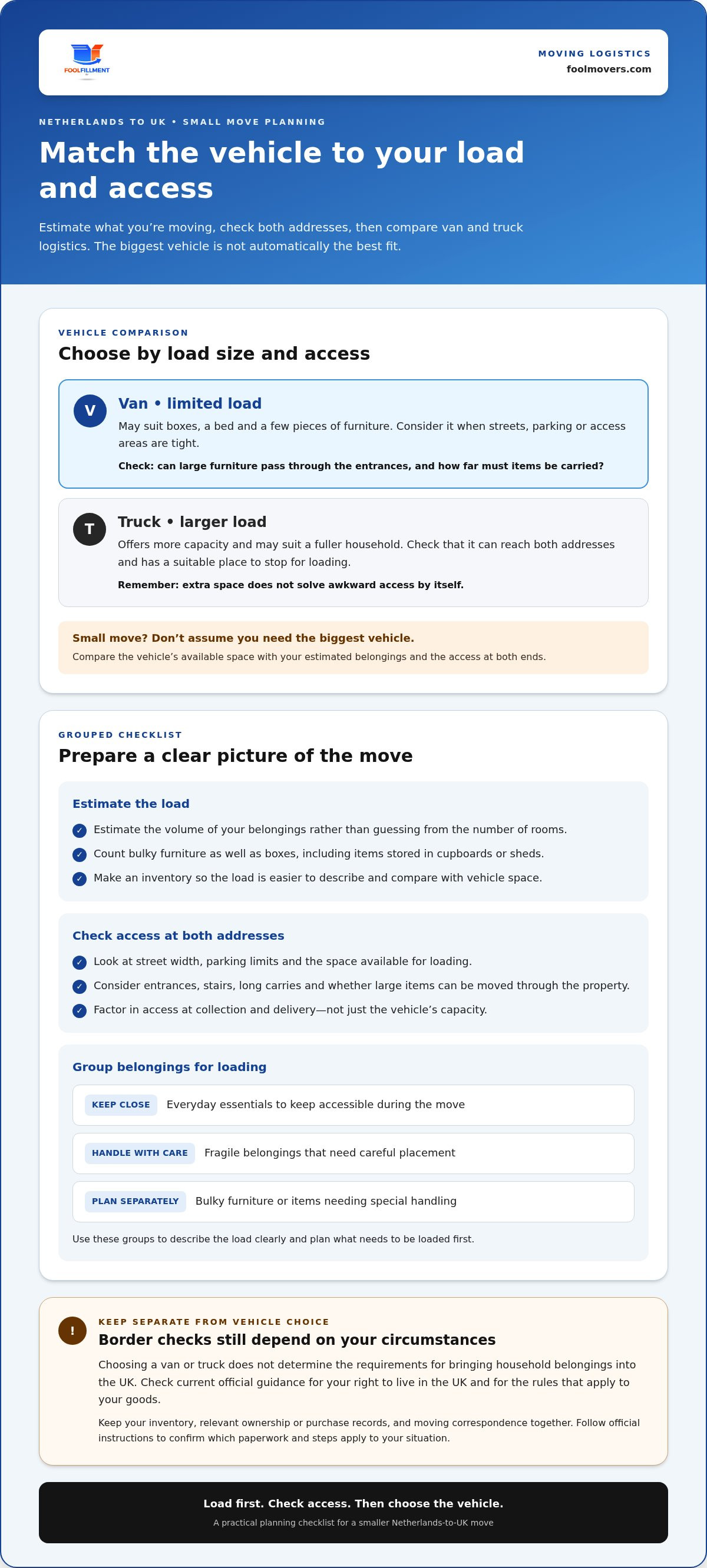
Choose transport based on the volume of your belongings, access at both addresses and how items need to be loaded. A van can suit a limited load of boxes, a bed and a few pieces of furniture. A truck offers more capacity, which may help with a fuller household, but can be harder to position where access is tight. Neither option is automatically right for every move.
Start by estimating the volume of your belongings. Count bulky pieces as well as boxes, and include items stored in cupboards or sheds. A clear estimate makes it easier to compare vehicle options than guessing from the number of rooms alone. For general home removals planning, this same load-first approach helps match transport to what you’re actually moving.
When can a van suit a smaller move?
A van may be practical when your load is limited and the collection or delivery point has narrow streets, restricted parking or a small access area. Check the route from the door to the loading point, whether large furniture can pass through entrances, and how far items need to be carried. A van isn’t automatically faster or suitable; the load and access at each address determine whether it’s a good fit.
When might a truck be more practical?
A truck may suit a larger household load that needs more space. Before choosing one, consider whether it can reach both addresses and where it can stop for loading. A larger vehicle does not solve awkward access by itself. Compare its available space with your estimated volume, then factor in stairs, long carries and any parking or entry limits.
Make your inventory easier to use by grouping items:
- Everyday essentials to keep accessible during the move
- Fragile belongings that need careful placement
- Bulky furniture or items needing special handling
Use these groups to describe the load clearly and plan what needs to be loaded first. For moving from Netherlands to UK after Brexit, keep transport planning separate from border checks: choosing a van or truck does not determine which official requirements apply.
Final checks before your move from the Netherlands to the UK
Use a final check to catch changes and loose ends, not to restart the whole plan. For moving from Netherlands to UK after Brexit, revisit official guidance close to moving day. Instructions can change, and your circumstances determine which ones apply.
A simple pre-move sequence
- Recheck official requirements. Review current UK guidance for your residence status and belongings. Keep customs checks separate from your transport checklist.
- Confirm transport arrangements. Make sure collection and delivery details, access points and loading plans are clear.
- Review your inventory. Compare the list with what you’ll actually take. Add anything missed and note fragile or special-handling items.
- Prepare essentials. Set aside personal items and records you’ll want to reach easily. Check that the planned load still fits the confirmed vehicle capacity.
Complete the official checks first, then use your inventory to organise loading. If your belongings or vehicle plan has changed, update the arrangements before moving day rather than relying on an old estimate. If your move also involves flying between the Netherlands and the UK to handle property handovers or viewings, resources like Compare Cheap Airport Parking can help you organise affordable vehicle parking across major UK terminals.
Get help with your moving questions
For moves outside the EU, customs assistance can help explain the process, but it does not replace official guidance or determine how a particular move will be treated. Check the relevant UK guidance for instructions that apply to your circumstances. For broader relocation planning, complete relocation solutions can help organise the practical details of a move.
If you’re planning a small move within Fool Movers’ European service network, contact Fool Movers to discuss your moving requirements.
Take the next step with a clear plan
Use your checklist as a working document, not a one-time task. If your move date, belongings or personal circumstances change, revisit the relevant official guidance and update your preparations. This helps keep your decisions grounded in current information while you focus on settling into your new home.
For small moves within its European service network, Fool Movers handles loads up to 12 m³ per move. The service includes a driver who helps with loading and unloading, and real-time tracking. If you’re planning a small move within the network, contact Fool Movers to discuss the practical details.
With the right checks in place, moving from Netherlands to UK after Brexit can feel more manageable. For professionals relocating for corporate commitments, arranging dependable London ground transport through JAF Executive Travels can make your arrival and early city travel seamless. Take it one decision at a time, and give yourself room to prepare with confidence.
Frequently Asked Questions
What changed when moving household belongings from the Netherlands to the UK after Brexit?
Brexit changed the UK’s broader relationship with the EU, so don’t rely on advice written for the pre-Brexit situation. If you’re moving from Netherlands to UK after Brexit, check current official UK guidance for your circumstances and belongings. The steps that apply can differ between movers and shipments. Use the guidance to identify what you need to do before finalising your plans.
Which documents do I need when moving from the Netherlands to the UK?
The documents you need depend on your move and current official requirements. Make an itemised inventory, listing furniture, boxes and any unusual or valuable items. Keep relevant personal and transport records together so you can find details quickly. Treat these as practical preparation, not a complete list of mandatory evidence. Check official UK guidance for required forms and supporting documents.
Do I have to pay customs duty when moving personal belongings to the UK?
There isn’t a reliable yes-or-no answer for every mover. The treatment of belongings can depend on current UK rules and your individual circumstances, so check official guidance for your situation before the move. Don’t assume that personal use automatically means duty won’t apply, or that a general checklist makes you eligible for an exemption. Verify any duty rules and conditions directly with official sources.
Can I move my belongings in a van when travelling from the Netherlands to the UK?
A van may suit a smaller load, but the right vehicle depends on the volume of your belongings and access at both addresses. A few boxes and small pieces of furniture, for example, may take less space than a full household’s contents. Check loading access and estimate the load before choosing transport. Vehicle choice is separate from border requirements, which you should verify through current official UK guidance.
Disclaimer
Website & Blog Disclaimer
Last updated: September 2026
The information published on Foolmovers.com, including articles, guides, tips, FAQs and other editorial content, is provided for general information and guidance only.
Accuracy of Information
Foolmovers makes reasonable efforts to ensure that the information published on this website is accurate and useful at the time of publication. However, information can change without notice, particularly regarding customs procedures, import and export requirements, transport regulations, documentation, taxes, duties, prices, travel restrictions and local regulations.
We therefore cannot guarantee that all information will always be complete, accurate or current.
No Professional Advice
Information published on Foolmovers.com should not be regarded as legal, tax, financial, customs, immigration or other professional advice.
Every international move is different. Requirements may depend on the countries involved, your personal circumstances, residency status, the goods being transported and current legislation.
For important decisions, you should verify the latest requirements with the appropriate authorities or a suitably qualified professional.
Customs & International Moves
Customs regulations and documentation requirements can change and may be interpreted differently by authorities in different countries.
Although Foolmovers can assist customers with transport documentation and customs procedures where applicable, information provided in our articles does not constitute a guarantee that a shipment will be accepted, cleared or exempt from duties, taxes, inspections or additional charges.
Any customs duties, taxes, government charges or third-party fees remain subject to the applicable authorities and service providers unless expressly agreed otherwise.
Prices & Costs
Any prices, rates, fees or cost estimates mentioned in our articles are provided for general guidance unless explicitly stated otherwise.
Actual transport, storage, customs and related costs may vary according to route, volume, dates, availability, fuel prices, tolls and individual circumstances.
For an accurate moving price, please request a personalised quotation from Foolmovers.
Third-Party Websites
Our articles may contain links to external websites, authorities, businesses or other third-party resources.
These links are provided for convenience and additional information. Foolmovers does not control these websites and cannot accept responsibility for their availability, accuracy, content, security or privacy practices.
The inclusion of an external link does not necessarily mean that Foolmovers endorses the organisation, service or information concerned.
Limitation of Liability
To the extent permitted by applicable law, Foolmovers cannot accept liability for losses, damages, costs, delays or other consequences resulting from reliance solely on information published in our articles, guides or other general website content.
Nothing in this disclaimer excludes or limits liability where doing so would be prohibited by applicable law.
Your Individual Move
Information found in one of our articles may not apply exactly to your situation.
If you're planning a European move, contact Foolmovers directly. We can look at your specific route, volume, dates and requirements and provide information relevant to your move.
Foolmovers
Small European Moves, Done Right.


