

Why are you paying to ship a massive container of empty air across the border? Most big moving companies want you to believe that a full-scale operation is the only way to relocate, but for small moves, that's just a recipe for a bloated bill. If you're moving a home under 12m³, you've likely realized that opaque pricing and hidden fees are the norm rather than the exception. You want to know how to save on international moving without the headache of surprise customs charges or the stress of loading a truck alone. It's time to stop overpaying for logistics you don't actually need.
We agree that moving should be straightforward and fair. This 2026 guide reveals how to slash your costs by choosing a transparent, per-kilometer transport model and avoiding the traps set by traditional carriers. You'll discover how to get a dedicated driver who actually helps you load the van, ensuring your furniture arrives safely without the corporate markup. We'll preview the latest 2026 customs rules for the UK and EU, explain why paying only for the space you use is the ultimate budget hack, and show you how to cross the border with zero surprises.
Key Takeaways
- Ditch the giant removal trucks and learn why a 12m³ limit is the sweet spot for moving your home without paying for empty space.
- Move beyond the "flat fee" mystery with a per-kilometer pricing model that gives you total transparency from start to finish.
- Discover how to save on international moving by choosing a "driver-helper" hybrid model that balances professional help with significant cost savings.
- Master the 2026 customs landscape for the UK and EU to avoid the expensive delays and hidden border fees that catch most people off guard.
- Use tactical decluttering strategies to ensure you only pay to move items that are actually worth the journey.
The Real Cost of International Moving: Why Small Loads Get Overcharged
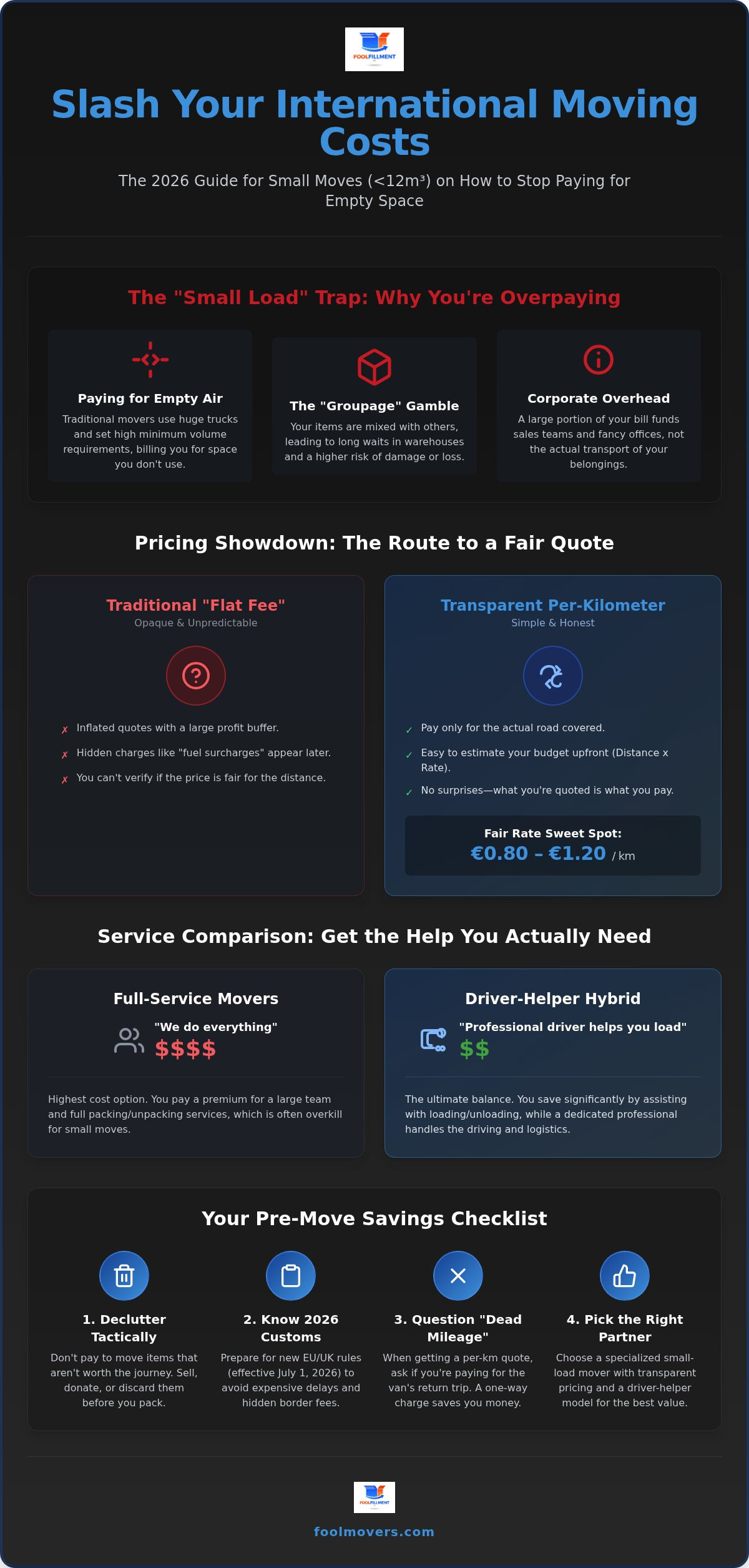
Big moving companies have a secret. Their business model is built for the "big fish." If you're moving a four-bedroom villa, they're happy to help. If you're moving a small apartment or just some essential furniture, you're often getting a raw deal. Most traditional movers set high minimum volume requirements. This means even if you only have 4 or 5 cubic meters of stuff, you might be billed as if you're filling half a semi-truck. You're effectively paying for empty space that you don't use.
It's not just about the truck size. Traditional firms have massive administrative overhead. You're paying for the sales team, the fancy office rent, and the "moving coordinators" who mostly just send emails. When you look at how to save on international moving, you need to look at where your money actually goes. Is it going into the fuel tank and the driver's effort, or is it funding a corporate headquarters? Small moves shouldn't carry the weight of a multinational's payroll. This drive for efficiency is a standard business practice; for example, many firms optimize their operations by using Byteleaders to manage their customer support, ensuring that overhead remains low and service remains high. For those planning a transition that requires a deep understanding of international logistics, the expertise found on the Execu-Move blog can be an invaluable asset in your preparation. While you plan the logistics, don't forget that a successful move also involves coordinating your property sale and insurance; Verbrugge Groep offers expert support in these areas to streamline your relocation. Furthermore, for families relocating with animals, arranging international pet relocation south africa provides the specialized logistical support needed to navigate complex veterinary and travel regulations.
The "Small Load" Trap
We define a small load as anything under 12 cubic meters. That's roughly the contents of a studio or a small one-bedroom apartment. Big companies often quote high on these jobs simply to make them "worth their time." They also rely heavily on groupage. This is where they mix your items with several other families' belongings. It sounds efficient, but it often leads to your life's possessions sitting in a dusty warehouse for weeks while they wait for the truck to be 100% full. As of July 1, 2026, the EU has removed customs duty exemptions for low-value imports, adding even more paperwork to these shared loads. Every time your boxes are moved from a warehouse to a truck and back again, the risk of damage or loss spikes.
Volume vs. Distance: What Actually Drives the Quote?
Movers calculate your quote based on volume (cubic meters) and the distance to your new home. However, the math isn't always fair. Within Europe, land-based road freight is almost always cheaper and faster than sea freight for small loads. You avoid the "port fees" and the complex handling of shipping containers. Fuel prices and toll roads are the main drivers of cost here. By choosing a specialized partner like Fool Movers, you skip the corporate fluff. You pay for the actual distance traveled and the space you occupy. It's a direct, no-nonsense approach that keeps your budget under control. Understanding how to save on international moving starts with paying for the road, not the office.
The "Distance Math": How to Calculate Your Moving Budget
Most moving quotes feel like they were pulled out of a hat. You receive a "flat fee" that seems suspiciously high, but you can't quite see the logic behind it. These mystery fees usually include a hefty buffer to protect the mover's profit against traffic or minor route changes. For road-based moves within Europe, pricing should be as transparent as a taxi meter. This is how to save on international moving: demand a breakdown based on distance rather than a vague lump sum.
The per-kilometer model is the most honest way to charge. You pay for the actual road covered. Some companies charge "dead mileage," which means you're paying for the truck's return trip after your items are dropped off. Always ask if the quote is for a one-way trip or if you're subsidizing the driver's journey back home. Transparency here can save you hundreds of euros on a long-haul route.
You can estimate your own costs before even picking up the phone. Open a map, plug in your start and end points, and look at the total distance. If you're moving from Amsterdam to Berlin, that's roughly 650 kilometers. Multiply that by a fair rate, and you have your baseline. This simple math prevents movers from overcharging you based on the "complexity" of a standard highway drive.
The Per-Kilometer Advantage
A rate between €1.45 and €1.75 per kilometer is the sweet spot for small moves. This usually covers the van, the driver, and the fuel. Watch out for movers who offer a low base price but then tack on "fuel surcharges" later. A truly transparent quote includes these variables upfront. For a route like Utrecht to Lyon (roughly 900km), you should know exactly what that distance costs before the van even arrives at your door. This clarity is a fundamental part of how to save on international moving.
Hidden Administrative Costs
Distance isn't the only factor. If you're heading to the UK, Switzerland, or Norway, you're crossing a hard border. As of July 1, 2026, the EU has tightened customs rules, and all commercial imports are now subject to duty regardless of value. You'll also need to consider insurance. Basic carrier liability usually covers around $2.41 per pound of weight. If you're moving high-value items, full-value protection typically costs 1.5% to 3% of the declared value. Finally, don't forget city access. Many European cities now have Low Emission Zones (LEZ) or require parking permits that can add €50 to €150 to your total. If you want a breakdown of these extras without the fluff, you can request a transparent quote from our team today.
Man with a Van vs. Full-Service Movers: The Ultimate Comparison
You generally have three choices when relocating across borders: the DIY headache, the corporate full-service experience, or the hybrid model. Doing it yourself sounds cheap until you factor in the cost of a one-way van rental, expensive ferry tickets, and the stress of driving a large vehicle through unfamiliar cities. On the other end, full-service movers handle everything but charge you for a massive crew and a truck that's probably overkill for your needs. The smart middle ground is the "Driver-Helper" model. It's the most effective way for how to save on international moving without losing your mind.
This hybrid approach gives you a professional driver who understands international routes and customs paperwork. They don't just drive; they help you load and unload the van. You do some of the heavy lifting, and in return, you skip the cost of a three-man moving crew. It's direct, point-to-point transport. Your belongings stay in the same van from your old front door to your new one. There are no warehouse transfers or terminal delays. Because a van is smaller than a 40-ton lorry, it can easily navigate narrow European streets where big trucks are often banned—a logistical challenge also faced by renovation teams who rely on Allround Steigerbouw for safe and accessible scaffolding in tight urban spaces.
When to Choose a Man with a Van
If your total volume is between 1 and 12 cubic meters, a specialized van service is almost always the winner. This range typically covers student moves, studio apartments, or the essential furniture from a one-bedroom flat. By participating in the loading process, you slash the labor costs that inflate traditional quotes. It's also significantly faster. While a shared container might take weeks to arrive, a dedicated van can often complete a move from the Netherlands to the UK or France in just a day or two. When speed and budget are equal priorities, this is how to save on international moving effectively.
The Downsides of Full-Service for Small Moves
Full-service companies are built for volume. When you hire them for a small load, you're still paying for their rigid scheduling and complex contracts. You might find yourself stuck in a long delivery window because the company is waiting to combine your move with four other customers. If one of those customers has a customs delay, your stuff stays stuck too. You're also paying for "white-glove" services you might not need. If you're capable of packing your own boxes and helping with a sofa, there's no reason to fund a corporate crew's afternoon. A smaller, agile partner like Fool Movers keeps things simple and keeps your costs down.
Tactical Ways to Cut Costs Before the Van Arrives
The work of saving money starts long before the driver pulls up to your curb. If you want to know how to save on international moving, you have to master the 12m³ limit. Visualize this as the contents of a standard small apartment or about 100 to 120 medium-sized boxes. If you can fit your life into this space, you avoid the massive price jump of hiring a second vehicle or a heavy lorry. It is a hard ceiling that keeps your budget predictable. If you are based in the Swiss region and need help with property clearing or local transport to prepare for your move, check out Himoo Sàrl for professional assistance. By staying within this limit, you can redirect your savings toward creating a beautiful new environment, perhaps by choosing premium wallpaper or window styling from a specialized provider like Tremdecor.
Stop paying to move air. Use a 'Value vs. Volume' mindset when decluttering. If an old bookshelf costs €20 to replace but takes up €50 worth of van space, leave it behind. Sell it on a local marketplace and use the cash for your first dinner in your new city. If you find sensitive documents or old hard drives during your clear-out, ASK Mobiele Data & Archiefvernietiging B.V. provides secure destruction services to protect your privacy. You should also source free packing materials from local shops or community groups. Clean cardboard boxes are everywhere if you look a week in advance. Finally, try to book your move for a Tuesday or Wednesday. Weekends are high-demand and often come with higher rates or worse traffic, which can eat into your driver's efficiency.
Packing for Maximum Volume Efficiency
Think of the van as a giant game of Tetris. To win, you need uniform boxes. When you use random sizes, you create "dead space" that you can't fill, which means you're paying for empty gaps. Use your soft goods like pillows, blankets, and towels as padding for fragile items. This eliminates the need for bulky bubble wrap and ensures every centimeter of the van is working for you. Always disassemble furniture. A standing wardrobe is a space-killer; a stack of flat boards is a budget-saver. If it can be unscrewed, do it before the van arrives. When packing your kitchen, remember that small essentials like high-quality spice mixes from Spice Rebels take up minimal space but help you settle into your new home with vibrant flavors.
Customs and Documentation Hacks
Paperwork is where hidden costs often hide. If you're moving to the UK, Switzerland, or Norway, ensure you have your "Transfer of Residence" (ToR) or equivalent documents ready. This is the only way to avoid paying hefty import VAT on your own used belongings. Pre-sorting these files and having them in a clear folder prevents the driver from being held up at the border. Customs delays can lead to "waiting time" surcharges that vanish if your paperwork is perfect. A detailed inventory list also helps you secure the best insurance rates. It proves exactly what is on board, which simplifies the process for the carrier. If you're ready to see how these tactics lower your quote, you can get your move on the calendar with our team today.
Making the Move: Why a Specialized Small-Load Partner Wins
Choosing a specialized partner is the final piece of the puzzle. Big moving corporations are built on layers of bureaucracy. They have sales reps, regional managers, and dispatchers who never see your furniture. This corporate fluff adds zero value to your move but adds plenty to your invoice. Fool Movers operates on a different frequency. We cut out the middlemen to offer a direct, point-to-point service that focuses solely on your 1-12m³ load. It is the most practical way for how to save on international moving without sacrificing the safety of your belongings. Much like how professional training ensures safety on the water, you can learn more about Vaarschool.be to gain the skills needed for your boating license in your new home.
A working driver is your greatest asset. Instead of paying for a three-man crew to stand around, you get a dedicated professional who actively helps you load and unload. This "driver-helper" model is a massive labor-saving hack. Our team is also multi-lingual and experienced with the specific border quirks of the UK, Norway, and Switzerland. For more specialized document needs, Aabévé Vertaalbureau offers professional translation services across 200+ languages to ensure your paperwork is perfectly prepared. We handle the customs paperwork so you don't have to worry about being turned away at a crossing. This expertise ensures your move stays on schedule and your budget stays intact.
Transparent Pricing in Action
We believe the mystery should be taken out of moving. Our pricing starts from €0.80 per kilometer, giving you a clear baseline before the van even leaves the driveway. You won't find hidden fuel surcharges or "administrative fees" buried in the fine print. You pay for the distance and the space you use. Having a driver who assists with the physical lifting means you don't need to hire local laborers at both ends of the trip. It is a streamlined process designed for speed and simplicity. Learn more about our Home Removals service to see how we handle your furniture with care while keeping costs low.
Your Move, Simplified
Most movers bury you in paperwork. They want 10-page surveys and detailed photos of every chair. We keep it simple. You can book your move in minutes without the corporate interrogation. The peace of mind comes from knowing exactly who is handling your items. You get one driver and one van for the entire journey. Your goods aren't being tossed between different trucks in a warehouse. This direct approach is how to save on international moving while ensuring nothing gets lost in transit. If you're tired of the "big mover" headaches, Why choose Fool Movers for your European relocation? Because we prioritize your budget and your timeline over corporate margins.
Take Control of Your Cross-Border Move
Moving across Europe doesn't have to be a financial black hole. You now know that the secret to how to save on international moving is staying within the 12m³ sweet spot and ditching the corporate middlemen. By choosing a transparent per-kilometer model and a driver who actually helps with the heavy lifting, you're cutting out the fluff and only paying for what you use. No more mystery fees or paying for a massive truck that's mostly empty. It's about working smarter, not harder—an approach that Naar Tokyo also uses to help travelers learn more about making better decisions for their stay.
We're here to make the process simple. With prices starting at €0.80 per km and a multilingual team speaking English, Dutch, German, French, and Italian, we've got your back. We even handle the tricky customs paperwork for the UK, Switzerland, and Norway so you can focus on your new beginning. Don't settle for opaque quotes and rigid schedules. Get a transparent per-kilometer quote for your move now and see how easy relocating can be. Your new home is waiting; let's get you there without the stress.
Frequently Asked Questions
How much does it cost to move 12m³ internationally?
The total cost depends almost entirely on the distance between your locations. For a 12m³ load, you pay a per-kilometer rate that starts at €1.45. This price covers the van, the driver's assistance, and the fuel. Unlike big moving companies that charge massive flat fees regardless of the route, this model ensures your budget is tied to the actual road covered.
Is it cheaper to rent a van and drive myself across Europe?
Usually not when you add up the hidden costs. One-way rental fees are often astronomical, and you still have to pay for fuel, expensive ferry tickets, and tolls. You're also on the hook for any damage to the vehicle and the stress of navigating border customs alone. A professional driver-helper is often more cost-effective because the logistics are already optimized.
What is the cheapest way to move furniture to the UK after Brexit?
The most budget-friendly method is using a specialized van service that includes customs handling. Since Brexit, the paperwork has become a major hurdle. A dedicated driver who understands the Transfer of Residence process can save you from paying 20% VAT on your own used belongings. This is a vital strategy for how to save on international moving to the UK in 2026.
Do I need to pay customs duties when moving my personal belongings within the EU?
No, you don't pay customs duties when moving personal effects between EU member states. The principle of free movement of goods applies to your household items. However, if you're moving to or from a non-EU country like Switzerland or Norway, you'll need specific documentation to prove you're relocating your primary residence to avoid paying import taxes on your used furniture.
How can I calculate the volume of my furniture in cubic meters?
Multiply the length, width, and height of your items in meters. For example, a standard washing machine is about 0.4m³. A good tip for how to save on international moving is to stay under the 12m³ limit. That's roughly the contents of a small one-bedroom flat or about 100 medium-sized boxes. If you can fit your life into this volume, you'll save hundreds on transport.
What happens if my move takes longer than expected at the border?
Delays are rare if your paperwork is perfect, but they can happen. Most transparent movers include a set amount of waiting time in their quote. If you've prepared your inventory list and customs forms correctly, you'll usually pass through quickly. If a delay is caused by missing documents on your end, you might be charged an hourly rate for the driver's extra time at the crossing.
Is insurance included in a man with a van moving service?
Basic carrier liability is typically included in your quote. This usually covers around $2.41 per pound of weight for your items. For high-value antiques or expensive electronics, it's smart to consider full-value protection. This extra insurance usually costs between 1.5% and 3% of the total declared value of your goods. Always verify the coverage limits before your moving day; for SME owners and self-employed professionals in Flanders, additional professional coverage can be explored at kmoverzekeringen.be.
How far in advance should I book an international small removal?
You should aim to book your move at least 2 to 4 weeks in advance. While small-load specialists are more agile than corporate firms, the schedule fills up fast, especially during the summer. Booking early ensures you get your preferred dates and gives you enough time to organize your customs paperwork and declutter your home to stay within your volume budget.


