

Most people moving heirlooms to Britain end up paying four times more VAT than they actually owe. It is a stressful thought, especially when you are already worried about a 200-year-old wardrobe surviving the trip across the border. Post-Brexit paperwork often feels like a minefield designed to catch you out. Getting the customs for shipping antique furniture to UK right isn't just about filling in boxes; it's about proving your item's history to the taxman.
We know you want your pieces to arrive in one piece without a massive, unexpected bill from HMRC. You deserve a move that is transparent and simple. This guide will show you how to hit the 100-year mark to unlock the reduced 5% VAT rate and avoid the standard 20% trap. We'll master the paperwork together so you can focus on where your furniture will sit in your new home.
We are going to break down the specific documents you need, how to handle CITES materials like rosewood, and the exact steps to ensure a smooth crossing. You will learn how to provide the right proof of age and why the right transport partner makes the border feel like a non-event. By the end, you will have a clear roadmap for a safe, tax-efficient move.
Key Takeaways
- Learn why proving your furniture is over 100 years old is the secret to cutting your import VAT from 20% down to just 5%.
- Master the essential paperwork, including the Commercial Invoice and Antique Declaration, to simplify the customs for shipping antique furniture to UK.
- Identify "red flag" materials like ivory or rare rosewood that require CITES permits to prevent your items from being held at the border.
- Understand how modern restorations can accidentally void your antique status and what documents you need to prove your item's history.
- Discover how small-load transport specialists can handle the customs headache for you while providing assisted loading for heavy, fragile pieces.
Understanding UK Customs for Antiques: The 100-Year Rule
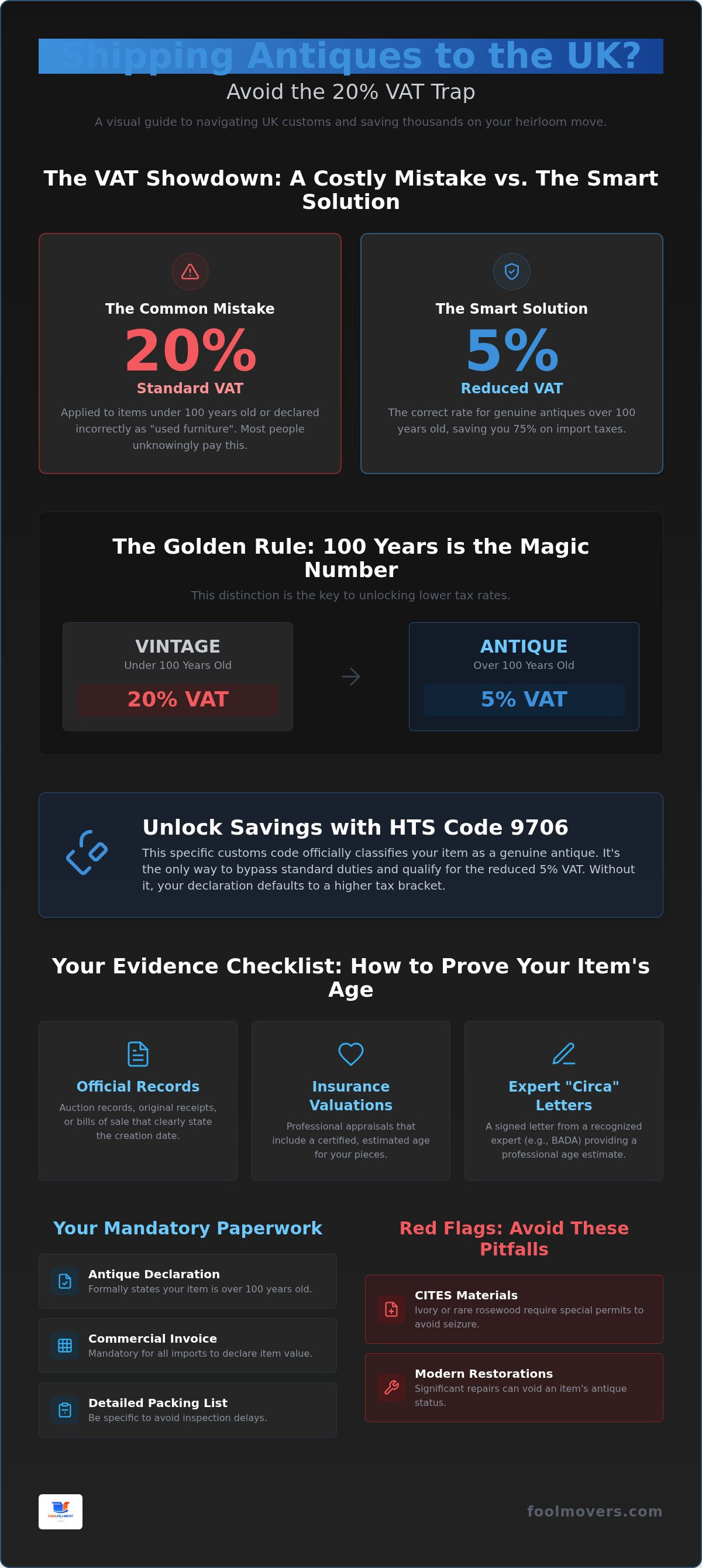
UK customs has a very specific line in the sand. If your furniture is 99 years old, it's "vintage" and you'll likely pay the standard 20% VAT. If it's 100 years or older, it's officially an antique. This distinction is the core of Understanding the 100-Year Rule. For anyone managing customs for shipping antique furniture to UK in 2026, this rule is your best friend. Since the post-Brexit tariff updates of 2025, EU-to-UK shipments are scrutinized just as strictly as those from the US or Asia. You can't just call a mid-century chair an antique to save money; the date matters.
To better understand how the UK handles restricted items and customs, watch this helpful video:
The 2026 landscape is all about digital precision. HMRC uses the Customs Declaration Service (CDS) to flag inconsistencies instantly. If you declare a Victorian sideboard but can't back up the date, the system defaults to the highest tax bracket. This is why distinguishing between "vintage" and "antique" is a financial decision, not just a stylistic one. Vintage items from the 1950s or 60s are popular, but they don't get the same tax breaks as a Georgian cabinet. You'll pay the full 20% VAT on those mid-century pieces, whereas true antiques qualify for a reduced 5% rate or even zero duty.
The HTS Code 9706 Advantage
When you fill out your customs declaration, the code you choose determines your bill. Most people mistakenly list their items as "used household goods" or "general furniture." This is a rookie mistake that triggers a 20% VAT charge. Instead, you want to use HTS Code 9706. This specific classification tells HMRC that your item is a genuine antique. HTS 9706 is the gold standard for duty-free furniture entry into the UK. By using this code, you signal that the item is over a century old. In the 2026 tariff environment, this code is the only way to bypass the standard import duties that apply to modern goods.
Proving the Age of Your Furniture
Customs officers aren't art historians. They won't just take your word that a mahogany desk is from the Regency era. You need proof. Ideally, you have auction records, original receipts, or insurance valuations that clearly state the age. If you're moving a family heirloom with no receipt, don't panic. You can obtain a "circa" letter from a recognized expert or a member of the British Antique Dealers' Association (BADA). This letter provides a professional estimate of the item's age based on construction techniques, materials, and style. When declaring the date, a specific "circa 1890" is much more powerful than a vague guess. Without this evidence, the customs for shipping antique furniture to UK becomes a lot more expensive very quickly. If the officer doubts the age, they will default to the 20% VAT rate, and reclaiming that money later is a bureaucratic nightmare you want to avoid.
Essential Paperwork: The Antique Declaration & Commercial Invoice
Paperwork is usually where a "no-hassle" move turns into a headache. When handling customs for shipping antique furniture to UK, you can't just wing it. HMRC requires a paper trail that proves your furniture isn't just old, but legally an antique. This starts with the Antique Declaration and the Commercial Invoice. Even if you aren't selling the items, these forms are mandatory for every border crossing in 2026. They're the difference between a smooth delivery and a warehouse storage bill.
A detailed packing list is your secret weapon. Don't just write "desk." List the detachable legs, the three drawers, and the brass key. If a customs officer opens your crate and sees five pieces when you listed one, they'll pull the whole shipment for inspection. If you're moving your entire home, you might qualify for Transfer of Residence (ToR) relief. However, antiques often sit in a grey area. Even with ToR, you still need to prove the age to avoid the 20% VAT trap on high-value items. For specific rules on cultural goods, check the official UK Customs for Antiques guidance.
How to Fill Out an Antique Declaration
This form is your legal bond with the UK government. You must be precise. The description should match your packing list exactly. For the age, don't just put "old." Use the "circa" date we discussed in the previous section. One critical field is the "Statement on Restoration." If your 18th-century chair has been reupholstered with modern foam and new springs, you must declare it. If more than 50% of the item is modern material, HMRC might reject its antique status. Sign it clearly; a missing signature is the fastest way to get your furniture stuck at the port for a week.
The Role of the Commercial Invoice in 2026
The most common mistake is putting "Value: £0" because the item is a gift or an heirloom. Customs doesn't believe in free furniture. You must declare a "fair market value." This is what the item would sell for at a public auction today. Don't guess; look at recent sales for similar pieces. In 2026, the Customs Declaration Service (CDS) requires all values to be converted to GBP. If you're moving from the EU, ensure your invoice shows the EUR amount and the GBP equivalent based on the current exchange rate. This value is used for both insurance and potential VAT calculations. If you're feeling overwhelmed by these forms, you can always reach out for a hand with your specific declaration.
VAT and Duties: Avoiding the 20% Trap
The difference between a successful move and a financial disaster often comes down to 15%. In the UK, the standard import VAT rate is 20%. However, genuine antiques over 100 years old qualify for a reduced rate of just 5%. This isn't a suggestion; it's a legal entitlement. When you are managing the customs for shipping antique furniture to UK, your goal is to stay firmly in that 5% bracket. If you fail to prove the age or use the wrong codes, HMRC will default to the higher rate. On a £10,000 heirloom, that mistake costs you an extra £1,500 at the border.
You also need to distinguish between "Works of Art" and "Antique Furniture." While both often enjoy the 5% VAT rate, they use different HTS codes. Furniture is functional. Art is decorative. If your antique desk is classified as a "collectors' item of historical interest" rather than furniture, the paperwork changes. Getting this right ensures you don't trigger unnecessary inspections that lead to delays and extra handling fees.
Restoration vs. Modification
HMRC follows a strict "essential character" rule. If you have an 18th-century table that has been repaired, you're usually safe. Replacing a broken handle or fixing a minor scratch with traditional wax won't void your antique status. The trouble starts with major structural changes. If you replace the entire mahogany top of a table with modern timber, it's no longer an antique. It's a "hybrid" piece.
Customs officers often apply a 50% rule. If more than half of the item consists of modern materials, it's reclassified as modern furniture. This triggers the full 20% VAT. Always keep documentation of any professional restoration work. A restorer's invoice detailing that they used period-correct methods helps prove the item's original character remains intact. Don't let a heavy-handed repair job turn your tax-free heirloom into a taxable modern import.
Customs Duty vs. Import VAT
It's easy to confuse these two costs. Under the UK-EU Trade and Cooperation Agreement, most antiques moving from the EU to the UK are duty-free. However, "duty-free" doesn't mean "VAT-free." You will almost always owe that 5% import VAT unless you qualify for specific reliefs like Transfer of Residence (ToR). ToR is great if you're moving your entire life, but it requires you to have owned the items for at least six months. For those just shipping a few specific pieces, understanding the nuances of VAT and Duties is essential. When handling the customs for shipping antique furniture to UK, always calculate your 5% VAT based on the fair market value plus shipping costs. It's the total landed cost that HMRC cares about.
Red Flags: CITES, Endangered Species, and Prohibited Materials
You might have the perfect 200-year-old piano, but it could still be seized at the border. When you handle the customs for shipping antique furniture to UK, the age of the item is only half the battle. The other half is what that item is actually made of. International treaties like CITES (the Convention on International Trade in Endangered Species) protect certain woods and animal products. If your furniture contains ivory, tortoiseshell, or specific types of rosewood, you need more than just a standard declaration. Without the right permits, UK Border Force has the legal right to confiscate your heirloom and issue a heavy fine.
The UK Ivory Act is particularly strict. It effectively bans the dealing of ivory, but there are narrow exemptions for antiques. Even if your piece is centuries old, you must register it or apply for an exemption certificate before it reaches the port. Identifying these materials early is vital. Look for cross-hatching patterns in ivory or the distinctive dark oily grain of rare woods. If you aren't sure if your mahogany desk has restricted rosewood inlays, get a professional opinion before you ship.
Shipping Rosewood and Mahogany
Not all rosewood is treated the same. Brazilian Rosewood (Dalbergia nigra) is the big one to watch out for. It has been heavily protected since 1992. If your antique has even a small amount of this wood in its inlays, you'll need a "Pre-Convention" certificate. This document proves the wood was harvested before the CITES protections began. Failing a CITES inspection is a disaster. It doesn't just mean a delay; it often results in the permanent seizure of the item. You cannot simply pay a fine to get it back. The item is usually destroyed or sent to a museum, leaving you with nothing but a legal bill.
The 1947 Rule for Worked Items
There is a glimmer of hope for most furniture owners known as the "worked" exemption. This applies to items made before June 1947. To qualify, the material must have been significantly altered from its natural state for jewelry, decor, or furniture construction. You must prove that the ivory or wood was "worked" into its final shape before this cutoff date. Most antique furniture with minor inlays qualifies if documented. This documentation often includes expert appraisals or detailed photographs showing the construction techniques used. It's about showing that the piece is a cultural object, not a modern way to smuggle endangered materials across the border.
The Smart Way to Move Antiques: Small Loads with Fool Movers
Big removal companies often treat your 18th-century desk like a standard box of books. They want to fill massive 40-foot containers and swap your items between multiple warehouses. This is where high-value antiques get damaged. We do things differently. Our 12m³ vans are the perfect size for small-scale international moves. You get a dedicated space for your heirlooms without paying for a massive truck you don't need. It's safer, faster, and much more personal.
Our pricing is as transparent as it gets. We charge based on the distance traveled, not some vague industry estimate. You pay for the kilometers we drive. This keeps costs down while ensuring your furniture gets the direct attention it deserves. Best of all, we handle the administrative headache. We manage the customs for shipping antique furniture to UK as part of the service. You won't have to guess which HTS code to use or worry about the 5% VAT declaration. We've got the paperwork covered from start to finish.
No-Nonsense Antique Transport
You don't need a "fine art" specialist with a 400% price markup to move a mahogany wardrobe. You need someone who knows how to lift, wrap, and secure a heavy piece of history. Our drivers aren't just steering the van; they assist with the loading. This is much safer than a self-drive rental where you're left to figure out the straps alone. We offer direct transport from the Netherlands to the UK. Your furniture stays on the same van from your old door to your new one. No hub-swapping means no unnecessary handling. Learn more about our Home Removals service to see how we handle these delicate trips.
Booking Your Move to the UK
Getting your antiques ready for a 12m³ van is simple. Measure your largest pieces first to ensure they fit our volume limits. Wrap the corners, remove any loose glass, and we'll handle the rest. Our booking process is fast. You get an instant quote based on the distance of your move. No hidden fees or surprise "customs processing" surcharges at the last minute. We believe in honesty and efficiency. Dealing with the customs for shipping antique furniture to UK shouldn't feel like a second job. Why Fool Movers is the right choice for small international moves comes down to one thing: we make the border feel invisible.
Secure Your Heirlooms for the Trip to Britain
Moving a century of history shouldn't feel like a gamble. You now know that the 100-year rule is your ticket to a 5% VAT rate instead of the standard 20% trap. By mastering the Antique Declaration and checking for CITES materials early, you've already solved the hardest part of the puzzle. The rest is just about choosing a partner who values your furniture as much as you do.
We take the weight off your shoulders by managing the customs for shipping antique furniture to UK as part of our direct service. You get a professional driver who helps with the heavy lifting and loading, ensuring your fragile pieces stay safe. With our kilometer-based pricing starting from €0.80/km, you only pay for the distance we actually cover. There are no hidden fees or complex hub-swaps; just a direct, honest journey from your old door to your new one.
Don't let paperwork or the fear of damage hold you back from bringing your favorite pieces along. Get a no-nonsense quote for your antique transport to the UK today. We'll handle the borders while you focus on settling in.
Frequently Asked Questions
Do I have to pay VAT on antique furniture imported to the UK?
Yes, but you usually qualify for a reduced rate. Genuine antiques over 100 years old are taxed at 5% import VAT instead of the standard 20% rate. To get this discount, you must provide HMRC with clear proof of the item's age. If you are moving your entire home, you might qualify for Transfer of Residence relief, which could bring your tax bill down to zero if you meet specific ownership criteria.
What paperwork is needed to ship 100-year-old furniture to the UK?
You need three core documents: a Commercial Invoice, a detailed Packing List, and an Antique Declaration. The declaration is your formal statement that the items meet the age requirements for duty-free entry. When managing the customs for shipping antique furniture to UK, you must use HTS code 9706 on your forms. If your furniture contains restricted materials like ivory or certain rosewoods, you will also need a CITES permit or exemption certificate.
How much does UK customs charge for shipping antiques?
UK customs generally charges 0% in tariff duties for antiques, but you must pay the 5% import VAT. This percentage is calculated based on the item's fair market value plus the cost of shipping and insurance. There are also small administrative fees for processing your entry through the Customs Declaration Service. Never list a "zero value" for heirlooms; customs will estimate their own value, which often leads to higher taxes and long delays.
Can I ship antique furniture with ivory inlays to the UK?
You can ship ivory, but only if you follow the strict 2026 Ivory Act rules. You must register the item or apply for an exemption certificate before it reaches the border. The piece must usually have been "worked" before 1947 and contain less than 10% ivory by volume. Shipping ivory without these permits leads to immediate seizure by Border Force and potential legal trouble, so always check your inlays before booking transport.
What happens if I don’t have an Antique Declaration form?
If you don't have this form, HMRC will likely reclassify your shipment as "used furniture." This mistake triggers the full 20% VAT rate instead of the reduced 5% rate. Your shipment might also be held in a bonded warehouse while customs officers wait for more information. These storage fees add up every day, so it's much cheaper to have your signed declaration ready before the van leaves for the UK border.
How do I prove my furniture was made before 1926 for the 100-year rule?
Proving age requires documented evidence like auction receipts, insurance valuations, or a letter from a recognized expert. A "circa" date from a member of the British Antique Dealers' Association is highly respected by customs. If you have no paperwork, professional photos showing construction methods like hand-cut dovetails can help an appraiser create a Statement of Age. This documentation is essential for the customs for shipping antique furniture to UK to ensure a smooth crossing.
Is it cheaper to use a small removal company for antiques?
It is usually much more cost-effective for small loads under 12m³. Large shipping lines charge for container space you won't use and often add high "fine art" premiums. With a small specialist, you get direct transport with no hub-swapping, which significantly reduces the risk of damage. You pay for the actual distance traveled, and having a driver who assists with loading ensures your heavy mahogany pieces are handled with the right expertise.
Does Brexit affect shipping family heirlooms to the UK?
Yes, Brexit changed the rules for all moves from the EU. Heirlooms that once crossed borders freely now require full customs declarations, just like shipments from the USA. You must now account for import VAT and provide proof of origin for every piece. While the UK-EU Trade Agreement keeps duties at 0% for most antiques, the administrative process is more complex. This makes having the correct paperwork more vital than it was before the transition.


