

Renting a big van and driving it yourself might seem like the cheapest way to handle your relocation, but it's often the most expensive mistake you'll make. Between the hidden insurance costs, the fuel, and the sheer stress of navigating a heavy vehicle through German traffic, the real cost to move furniture to Germany from Netherlands often spirals out of control. It's frustrating to realize that many traditional moving companies don't even want to talk to you if your load is under 12m³. You're stuck between a rock and a hard place, overpaying for a giant truck or risking your back and your sanity doing it all alone.
We get it. You want your stuff in your new home without the headache of a surprise bill at the end. This 2026 guide breaks down exactly how to calculate your cross-border moving expenses and why kilometer-based pricing is the smartest choice for small-to-medium loads. We'll show you how to secure a fixed, transparent price that includes professional help with the heavy lifting. You'll learn how to skip the rental desk, avoid those annoying hidden fees, and enjoy a stress-free border crossing with a pro by your side.
Key Takeaways
- Learn how kilometer-based pricing starting at €0.80 provides a transparent baseline for your cross-border budget.
- Discover why a 12m³ van is the most efficient choice for small-to-medium moves compared to expensive freight trucks.
- Calculate the real cost to move furniture to Germany from Netherlands by factoring in driver assistance and fuel.
- Save on total expenses by using professional disassembly techniques to maximize every cubic meter of van space.
- Avoid the stress of foreign traffic and heavy lifting with a service that includes a driver who helps you load and unload.
Understanding the Cost to Move Furniture to Germany from Netherlands
Moving your belongings across the border isn't a one-size-fits-all situation. The total cost to move furniture to Germany from Netherlands usually boils down to three main factors: the total volume of your items, the distance between your front doors, and the level of help you need. While the Freedom of movement in the EU makes the legal side of your move simple, the logistics require a bit more thought. You aren't just paying for a driver; you're paying for space and time.
Relocating to Germany presents a unique "mid-range" logistics challenge. It's too far for a simple afternoon trip with a borrowed trailer, but it's often too small for the massive container ships or 40-ton trucks used for global hauls. Most people find themselves in the middle. You need more than a car but less than a cargo ship. That's why choosing between "transport-only" and "assisted removal" is your first big decision. Transport-only means the driver just watches you sweat while you load the van. Assisted removal means you get a professional who helps you carry that heavy oak wardrobe down the stairs.
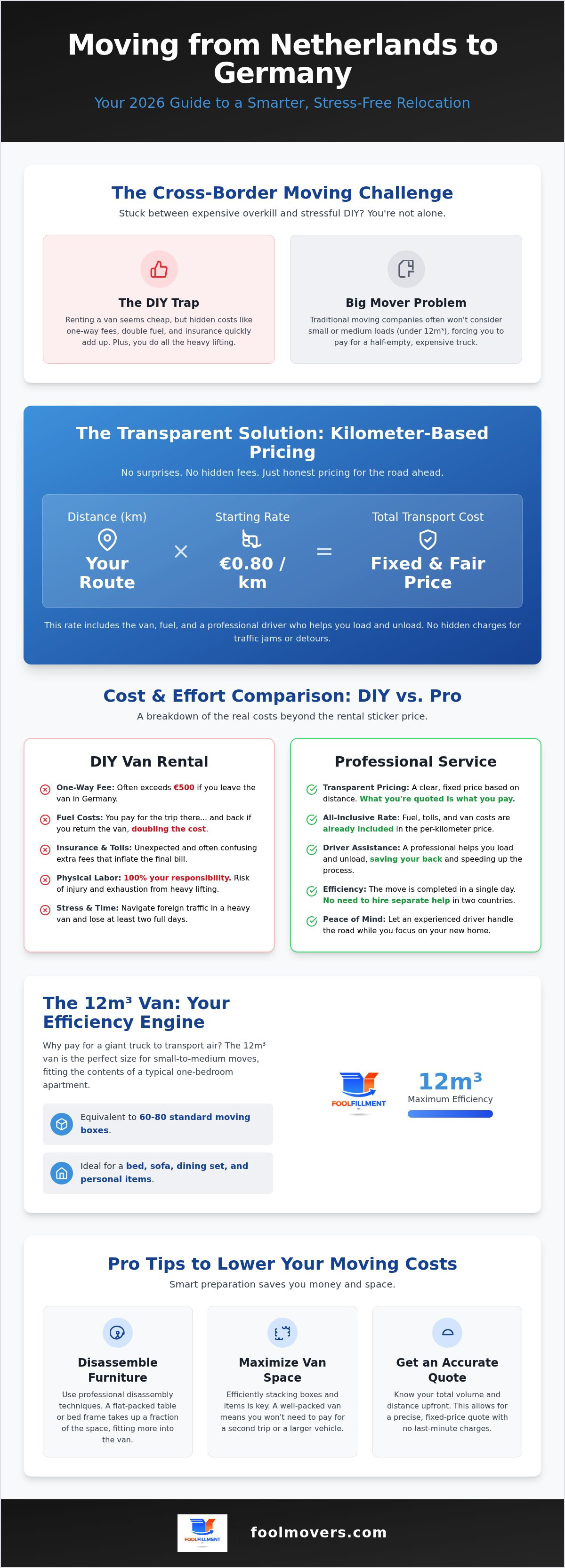
A 12m³ van is the absolute sweet spot for small-to-medium furniture moves because it perfectly fits the contents of a standard one-bedroom apartment without the unnecessary expense of a half-empty freight truck.
Total Volume vs. Truck Size
Estimating your volume is where most people get stuck. A 12m³ capacity is roughly equivalent to 60 to 80 standard moving boxes. If you're moving a bed, a sofa, a dining set, and some personal items, this size is usually perfect. Paying for a massive 20m³ truck when you only have 10m³ of stuff is just throwing money away. You're essentially paying a premium to transport Dutch air across the border. Small load specialists focus on filling the van efficiently, which keeps your costs down and the process moving fast.
The Hidden Costs of DIY International Moving
Renting a van yourself sounds cheap until you do the math. Most rental companies charge a massive "one-way" fee if you leave the van in Germany, often exceeding €500. If you drive it back to the Netherlands, you've doubled your fuel costs and spent two days on the road instead of one. Don't forget the tolls and the high fuel consumption of a fully loaded van. When you add the physical risk of moving heavy furniture without experience, a professional home removals service often costs less than the "cheap" DIY route. It's about saving your wallet and your back at the same time.
The Transparent Math: How Kilometer-Based Pricing Works
Forget the complicated weight scales or confusing volume brackets. Most shipping platforms ask you to guess the exact weight of your sofa or the precise dimensions of your bed. It is a headache you don't need. For 2026, a transparent baseline for the cost to move furniture to Germany from Netherlands starts at €0.80 per kilometer. This approach is refreshingly honest. You pay for the actual journey, not a made-up "flat fee" that usually hides a massive profit margin for the mover. Hourly rates for international trips are even riskier. If there is a traffic jam on the autobahn, you shouldn't have to pay for the driver to sit there. Distance-based pricing fixes that.
This rate is not just for the wheels. It is a total package that includes the fuel, the 12m³ van, and a professional driver who knows the cross-border routes. Most importantly, it includes the driver's expertise and physical help. They don't just sit in the cab. They help you move. While the transport cost is tied to the distance, the time spent loading and unloading is factored in separately to ensure you only pay for the labor you actually use. It keeps the bill predictable and fair.
Calculating the Distance from Departure to Destination
Estimating your bill is simple. Use a standard mapping tool to find the distance between your current home in the Netherlands and your new doorstep in Germany. Multiply those kilometers by the rate. A fixed price per km protects you from "traffic surprises" or unexpected detours. Whether the trip takes four hours or six due to roadwork, your transport fee stays the same. You can see a full breakdown of how this works on the Fool Movers homepage. It is the most predictable way to budget for an international move without the fear of hidden surcharges.
Value-Added Services: Driver Assistance
The real value isn't just the van; it's the person behind the wheel. Hiring a "man with a van" means you don't have to hire separate local labor in two different countries. Finding reliable helpers in a new German city where you might not speak the language yet is a major stressor. Usually, our service includes a set amount of physical help with loading and unloading. This saves you hundreds of euros compared to hiring "labor-only" movers at both ends of the trip. It turns a stressful day into a managed, professional process. If you have a specific list of items and want to see how the math works for your route, get a clear quote today.
Movers vs. Shipping Platforms vs. DIY: A Cost Comparison
The price difference between a courier, a massive truck, and a dedicated van is huge. For a 500km journey, the industry average for professional transport typically falls between €390 and €1,108. However, the level of service you get for that money varies wildly. Shipping platforms often feel like the cheapest route for a few boxes, but they fail the moment you have a dining table or a bed. Full-service movers offer the most luxury, but they come with a "Platinum" price tag that can exceed €3,400 for an all-inclusive move. Choosing the right method changes everything about the total cost to move furniture to Germany from Netherlands.
Our model at Fool Movers bridges the gap. We provide a 12m³ van and a driver who helps you with the heavy lifting. It’s a direct A-to-B service. Unlike shipping platforms, your furniture isn't moved between multiple warehouses. Unlike full-service firms, you aren't paying for a 40m³ truck to carry 5m³ of furniture. You can learn more about why our model works for small-to-medium relocations. We focus on speed and transparency without the corporate fluff.
When to Choose a Shipping Courier
Shipping platforms and couriers are great for boxes, but they are a nightmare for furniture. Most couriers require you to palletize your items. This means you have to buy a pallet, strap your sofa to it, and wrap it in industrial plastic. If you don't, they won't take it. The cost of crating and the risk of damage during warehouse transfers often outweigh the initial savings. Couriers use a "hub-and-spoke" system. Your furniture might be loaded and unloaded four times before it reaches Germany. Every time it's moved, the chance of a scratch or a broken leg increases.
When a Full-Service Truck is Overkill
Large international moving firms often have a "minimum volume" trap. They might charge you for 15m³ or 20m³ even if you only have 8m³ of stuff. They use massive 40m³ trucks that struggle to navigate narrow residential neighborhoods in German cities. You end up paying a premium for a giant truck that is mostly filled with Dutch air. Smaller vans are much more maneuverable. They can park closer to your front door, which speeds up the loading process and reduces the distance you have to carry heavy items. If your move fits in 12m³, a full-service freight truck is simply overkill for your budget.
How to Lower Your Moving Costs to Germany
Cutting the cost to move furniture to Germany from Netherlands isn't about finding the cheapest, riskiest mover. It's about being smart with the space you've got. Since you're paying for a dedicated trip, you want every cubic meter to work for you. Every item you pack should earn its place in the van. Here are four practical steps to keep your bill as low as possible.
- Step 1: Decluttering. Every item you leave behind is money in your pocket. Be ruthless. If you haven't used that old armchair in a year, don't pay to drive it 600 kilometers.
- Step 2: Disassembly. Furniture takes up way less space when it's flat. Take the legs off tables and dismantle large wardrobes. Flat items stack easily and leave more room for your boxes.
- Step 3: Flexible scheduling. If you aren't tied to a specific morning, let us know. Sometimes we can coordinate routes to make the logistics even more efficient for everyone.
- Step 4: Efficient packing. Use uniform moving boxes. When every box is the same size, they stack like bricks all the way to the ceiling. It prevents shifting and uses every inch of the van.
Following these steps ensures you get the most out of your budget. You'll avoid the need for a second trip and keep the total cost to move furniture to Germany from Netherlands within your target range.
Maximizing the 12m³ Van Capacity
Visualizing 12m³ is easier than you think. It's roughly the contents of a well-furnished one-bedroom apartment. This usually includes a bed, a sofa, a dining set, and about 40 to 50 boxes. Our drivers are experts at this. They don't just drive; they help you stack items safely. They know how to place heavy items at the bottom and secure everything with straps so nothing slides around on the Autobahn. It's about safety and efficiency. A well-packed van means you won't need a larger, more expensive truck that you don't actually need.
Documentation and Customs Prep
Moving between EU countries is simple, but you still need to be organized. Having a clear inventory list is vital for your own peace of mind and for insurance purposes. It helps you keep track of what's in which box. We handle the "no-nonsense" side of the cross-border paperwork so you don't have to worry about legal hurdles. You can read more about why us is the right choice for a transparent, stress-free move. We keep the process simple so you can focus on your new life in Germany. If you're ready to see how much you can save, get your custom quote now.
Booking Your Move: Getting an Accurate Quote
Getting a quote shouldn't feel like a guessing game. To calculate the real cost to move furniture to Germany from Netherlands, you need three pieces of information ready. First, the exact distance from your current door to the new one. Second, a realistic list of your items. Third, the access details. Are there three flights of stairs? Is the street too narrow for a van? Sharing these details upfront prevents price shocks later. Unlike impersonal shipping platforms that treat you like a tracking number, we offer a personal, multilingual experience. Whether you prefer Dutch, English, or German, we speak your language. It makes the whole process feel like a conversation with a pro, not a computer.
On moving day, the process is straightforward. Your driver arrives on time, assesses the load, and starts the loading process with you. It is a collaborative effort. Before the van leaves, we do a final check to ensure everything is secure. We also make sure your items are covered by statutory carrier liability. This is the standard for EU moves. It gives you peace of mind while your belongings are cruising down the Autobahn.
The Fool Movers Booking Process
We move fast from your initial inquiry to a fixed-price confirmation. We don't do "vague estimates" that double on moving day. If you have special requirements, tell us. We regularly handle home removals that include motorcycles, scooters, or delicate antiques. These items need extra care and specific loading techniques. Once we agree on the price, it's locked. You won't find hidden fees for fuel or "international surcharges" tucked away in the fine print. We keep it simple, direct, and honest.
Preparing for Destination Germany
Germany has specific rules you need to know before the van arrives. In many German cities, you might need an Umzugshalteverbot. This is a temporary parking permit that reserves a spot right in front of your new building. Without it, the driver might have to park far away, which adds hours to the unload. Check the local regulations for your new neighborhood at least two weeks in advance.
Make sure the access at the new address is clear. Are the keys ready? Is the elevator working? Once we arrive, the driver helps with the final unload. They don't just drop your boxes on the sidewalk. They help you carry the heavy furniture inside so you can start settling in immediately. It's the final step in a move that's built on transparency and hard work.
Start Your Move to Germany Today
Moving house doesn't have to be a financial black hole or a logistical nightmare. You now know that the smartest way to manage the cost to move furniture to Germany from Netherlands is through transparent, kilometer-based pricing. By focusing on a 12m³ capacity and taking the time to declutter and disassemble your furniture, you're already ahead of the game. You've swapped the stress of a bulky rental van for a professional service that actually helps with the heavy lifting.
We take pride in being the no-nonsense partner for your relocation. With our €0.80/km baseline and driver assistance included in every quote, you get total price certainty before the van even arrives. There are no hidden fees or surprise surcharges here. We focus on small-to-medium moves because we know that's where you need the most flexibility and the best value.
Ready to get moving? Calculate your fixed-price move to Germany with Fool Movers and let us handle the road while you focus on your new home. Your German adventure is just a few clicks away, and we're ready to help you get there safely.
Frequently Asked Questions
Is it cheaper to move furniture by courier or a moving van?
A moving van is almost always cheaper for actual furniture like sofas or beds. Couriers usually require you to palletize and crate your items, which adds significant costs for materials and labor. For the total cost to move furniture to Germany from Netherlands, our dedicated 12m³ van avoids the "hub-and-spoke" damage risks of traditional shipping. You save money by skipping expensive crating and avoiding warehouse transfer fees.
How is the distance calculated for a move from the Netherlands to Germany?
We calculate the distance using standard mapping tools to find the most efficient route between your two addresses. This total mileage is multiplied by our transparent €0.80/km rate to create your baseline. We don't charge extra for traffic jams or roadwork detours once the price is fixed. It's a simple, honest system that ensures you know the transport costs before the driver even arrives at your door.
Do I need to pay customs duties when moving furniture between NL and DE?
No, you don't have to worry about customs duties or import taxes. Since both the Netherlands and Germany are EU member states, your personal household goods can move freely across the border. You just need a valid passport and proof of your new address for residency registration. This lack of red tape is a major reason why the cost to move furniture to Germany from Netherlands stays predictable and affordable.
Can the driver help me disassemble my IKEA furniture?
Yes, our drivers are hands-on and can assist with basic disassembly and reassembly. We always recommend making furniture "flat" to maximize the 12m³ space in the van. While you should have your own tools ready, the driver provides the extra muscle and expertise to ensure everything is taken apart safely. This help is part of our standard service to take the physical stress out of your moving day.
What is the maximum volume I can move with Fool Movers?
Our maximum capacity is 12m³ per trip, which is the perfect "sweet spot" for small-to-medium relocations. This volume comfortably fits the contents of a standard one-bedroom apartment, including your bed, sofa, and about 50 boxes. We don't handle massive villa moves that require 40-ton freight trucks. By specializing in this specific size, we keep our operations efficient and our pricing much lower than traditional international moving firms.
How do I protect my furniture for a long-distance drive?
Use moving blankets and industrial stretch wrap for all your large items. Your driver will help secure everything with professional straps inside the van to prevent shifting during the drive on the Autobahn. Focus on protecting the corners of tables and the legs of chairs. Since we provide a direct A-to-B service, your furniture isn't moved between warehouses, which drastically reduces the risk of accidental scratches or damage.
Are there extra costs for moving furniture to higher floors?
We factor the complexity of the move into the initial quote to avoid surprise fees. If you're moving to the fourth floor without an elevator, let us know during the booking process. While the kilometer rate is fixed, the loading and unloading time is adjusted based on the access details of both properties. We believe in transparency, so we ask about stairs and parking upfront to ensure your final bill is accurate.
How far in advance should I book my move to Germany?
We recommend booking at least 2 to 3 weeks in advance to secure your preferred date. This is especially important during the peak summer months of June to August when demand for cross-border moves is highest. If you're moving during the off-season from September to April, we might have more flexibility. However, early booking always gives you more time to declutter and prepare your inventory list for a stress-free experience.


