


Transporting Antique Furniture Across Europe: The Basics
Moving a standard sofa is about muscle. Moving a 200-year-old Biedermeier chest is about precision, care, and expertise. When you need to transport antique furniture across Europe, you’re not just moving wood and fabric; you’re moving history. The logistics involved go far beyond simply getting from point A to point B. It requires a deep understanding of European road networks, cross-border regulations, and the unique vulnerabilities of aged materials.
This process is often part of a larger estate management task; for properties located in the Ruhr region, Immobilienmakler & Hausverwaltung Mülheim an der Ruhr provides the professional brokerage and valuation expertise needed to handle such transitions.
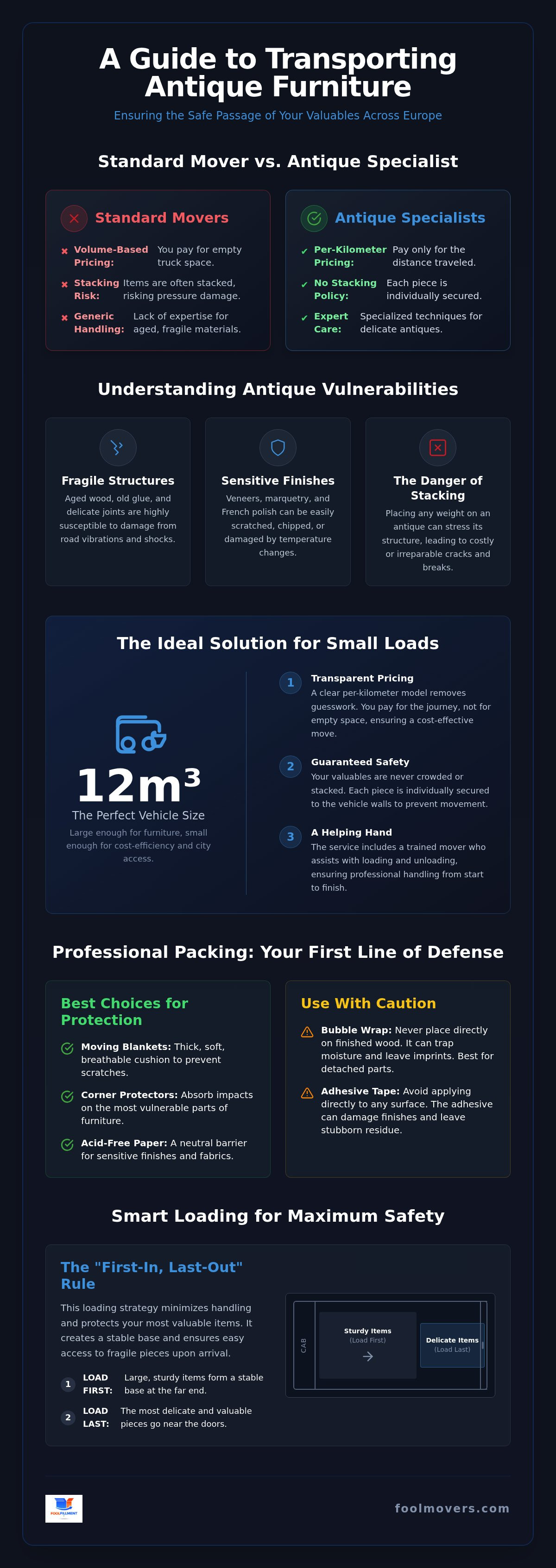
Many people turn to large, all-in-one moving companies, only to find themselves paying for a half-empty truck. These services often charge for volume, meaning you pay for the empty space around your precious items. Standard furniture transport is designed for modern, durable goods. Antique transport is a specialized craft, focused on preservation from start to finish.
Why Antiques Need More Than a Standard Move
Your antique furniture has survived decades, even centuries. A single poorly planned move can undo all of that. Standard movers often lack the specific knowledge required to handle these fragile pieces.
- Fragile Structures: Aged wood, delicate joints held by old glue, and intricate carvings are extremely vulnerable to vibrations and shocks. Your furniture needs a vehicle with soft suspension and a driver who knows how to navigate roads smoothly, not a rattling trailer packed to the ceiling.
- Sensitive Finishes: Veneers, marquetry, and French polish can be easily scratched, chipped, or damaged by temperature fluctuations. They can't be casually stacked or placed next to loose, hard-edged boxes. A climate-stable environment is crucial, which is why many storage facilities utilize specialized Industriële verwarming systems to maintain optimal conditions.
- The Danger of Stacking: For antique preservation, "stacking" is the enemy. Placing weight on an antique piece, even a well-wrapped one, can stress its structural integrity, leading to cracks or breaks that are costly or impossible to repair. Each piece needs its own space, properly secured.
The Cost-Effective Alternative for Small Loads
You don't need a museum-grade crate and a 40-tonne truck to move a family heirloom. The solution for most private antique collections or single-item moves is a dedicated, smaller vehicle. This approach offers both safety and affordability.
- The Ideal Volume: A 12m³ van is the sweet spot for most antique shipments. It’s large enough to hold several pieces of furniture without crowding them, but small enough to be cost-effective and navigate narrow European city streets.
- Transparent Pricing: Forget confusing quotes based on weight and volume. A clear, per-kilometer pricing model removes all guesswork. You know exactly what you're paying before the journey begins, allowing you to budget with confidence.
- A Helping Hand: What good is a transport service if you’re left to do the heavy lifting alone? The true value comes from a driver who is also a trained mover, ready to help you safely load and unload your valuables at both ends of the journey.
Protecting Your Valuables: Essential Handling and Packing
The safety of your antique furniture is determined long before it’s loaded into the van. Proper preparation is non-negotiable. It requires a methodical approach, the right materials, and an understanding of what not to do.
Start by creating a detailed inventory. Photograph every piece from multiple angles, paying close attention to existing imperfections or marks. This checklist is not just for your records; it’s an essential document for insurance and customs. When prepping, avoid common mistakes like applying tape directly to wood finishes or using harsh cleaning chemicals. Finally, remember that securing the load is a science. Straps must be used to prevent any movement, but they must be applied with padding to ensure they don't leave pressure marks on delicate surfaces.
Professional Packing Materials That Work
The materials you use to protect your antiques are your first line of defense against damage. Not all packing supplies are created equal, and using the wrong one can cause more harm than good.
- Moving Blankets vs. Bubble Wrap: Thick, padded moving blankets are the primary tool for protecting antique furniture. They provide a soft, breathable cushion that prevents scratches and dings. Bubble wrap should be used sparingly, primarily for detached parts like legs or finials, but never placed directly against a delicate wood finish, as it can trap moisture and leave imprints.
- Corner Protectors and Edge Guards: These simple foam or cardboard pieces are the unsung heroes of antique safety. They absorb impacts on the most vulnerable parts of your furniture—the corners and edges—preventing chips and dents during loading and transit.
- Acid-Free Paper: For items with sensitive finishes, paintings, or delicate fabrics, a layer of acid-free tissue paper is essential. It creates a neutral barrier that prevents chemical reactions or color transfer that can occur with standard packing paper or plastics.
Loading and Securing Fragile Items in the Van
How your furniture is arranged and secured inside the van is just as important as how it's packed. A professional mover follows a strict process to ensure nothing shifts, even on bumpy roads or sharp turns on European motorways.
- The "First-In, Last-Out" Rule: The largest, sturdiest, and least fragile items are loaded first to create a stable base. Your most delicate and valuable pieces should be loaded last, near the doors, so they are the first to be unloaded. This minimizes handling and reduces the risk of damage.
- Strategic Strapping: A well-equipped van has multiple floor-to-ceiling strapping points. These allow items to be secured individually against the walls of the van, preventing them from shifting or rubbing against each other. Each strap is tightened to be snug, but not so tight that it puts undue pressure on the item.
- To secure a heavy antique wardrobe, a wide, padded strap should be placed horizontally across its mid-section, ensuring the pressure is distributed evenly across its strongest structural points and not on delicate doors or carvings.
Choosing the Right Service: Full Truck vs. Small Load
The European antique transport market is filled with options, but they generally fall into two categories: massive, full-service logistics companies and smaller, specialized movers. For the individual collector or someone moving a few inherited pieces, the choice can have a huge impact on cost, timing, and peace of mind.
Full-size moving trucks, while necessary for whole-house relocations, are often impractical for antique transport. They struggle with the narrow streets of historic European cities and their sheer size means higher fuel and toll costs, which are passed on to you. "Shared load" or "groupage" services might seem cheaper, but they come with hidden costs: your priceless armoire might be loaded and unloaded multiple times to make way for other customers' goods, and you’ll be subject to their schedule, leading to significant delays. A dedicated 12m³ van, on the other hand, offers a direct, secure, and surprisingly fast alternative.
Why the 12m³ Limit Saves You Money
Bigger isn't always better, especially when it comes to logistics. Opting for a service that specializes in smaller loads is the smartest financial decision for most antique moves. The efficiency of a smaller vehicle translates directly into savings for you.
- Pay for Distance, Not Air: With a dedicated van, you are paying for your specific route. You aren't subsidizing the empty space in a giant trailer or the detours required for other deliveries. It’s a direct, A-to-B service priced accordingly.
- Lower Operational Costs: A 12m³ van consumes significantly less fuel and incurs lower road tolls than a large truck. These operational savings are reflected in a more competitive rate for the customer.
- The Specialist for This Volume: Fool Movers has built its entire model around this efficient 12m³ volume. We provide the perfect balance of space and cost-effectiveness, ensuring your antiques get the dedicated service they deserve without the full-truck price tag. For more on this, see our complete guide to small moves in a 12m³ van.
The Man with a Van Advantage for Antiques
The term "man with a van" can sometimes suggest a lack of professionalism, but for antique transport, a specialized version of this model offers unmatched benefits. It’s about directness, flexibility, and a personal touch that large corporations simply cannot replicate.
- Direct Communication: When you book with a smaller, dedicated service, you’re often speaking directly with the person who will be handling and driving your furniture. There are no call centers or dispatchers—just clear, direct communication.
- Unmatched Flexibility: Need to adjust your pickup time by a few hours? A large logistics company might charge a hefty fee or say it's impossible. A smaller operator has the agility to adapt to your schedule, making the entire process less stressful.
- The Driver is Your Partner: Your driver isn't just a pilot. They are an experienced mover who acts as a second set of hands, helping you with the difficult and heavy work of loading and unloading. This personal assistance is invaluable when dealing with irreplaceable items.
Navigating Cross-Border Logistics and Customs
Transporting antiques within the EU is relatively straightforward, but the moment you cross a border into a non-EU country like the UK, Switzerland, or Norway, a new layer of complexity arises. Customs declarations, VAT, and import duties become critical considerations. Without expert knowledge, your shipment can face costly delays or even be seized at the border.
You’ll need to prove the value and origin of your antiques, and the rules can differ for items you’ve purchased versus items you’ve inherited or are moving as part of your personal belongings. A professional transport company doesn’t just drive the van; they act as your administrative partner, managing these bureaucratic hurdles so you don’t have to.
Moving Antiques to the UK, Switzerland, and Norway
These three non-EU destinations are common for antique transport, and each has its own specific set of rules. Navigating them requires up-to-date knowledge and meticulous paperwork.
- United Kingdom: Post-Brexit, moving furniture from the EU to the UK requires a formal customs declaration. We handle the entire process for you, including preparing the necessary inventory lists and value declarations to ensure a smooth crossing. Read our detailed guide on moving to England after Brexit for more information.
- Switzerland & Norway: As non-EU members, both Switzerland and Norway have stringent border controls. We manage all the required transit documents (like the T1 or T2 forms) and ensure your paperwork is in perfect order before we even start the engine, preventing any issues at the border. Our guide to relocating to Switzerland covers many of these details.
- The Fool Movers Solution: We take the "customs headache" completely off your plate. Our team is experienced in the specific requirements for personal antique shipments to these countries, ensuring a seamless and stress-free border crossing every time.
Required Documentation for Antique Transport
Proper documentation is the key to a successful international antique move. Missing or incorrect paperwork is the number one cause of delays at customs. Here’s what you’ll typically need:
- Detailed Packing List & Invoice: You need a comprehensive list of every item being transported, along with its description, age, and value. For purchased items, a commercial invoice is needed. For personal belongings, a pro-forma invoice is used.
- Proof of Origin: For items over 100 years old (the general definition of an antique for customs purposes), proof of origin and age can be crucial for qualifying for reduced or zero import duties. This can include appraisals, receipts, or letters of provenance.
- A CITES permit is a mandatory international certificate required for the transport of items made from or containing materials from endangered species, such as certain types of ivory, rosewood, or tortoiseshell.
Reliable Antique Furniture Transport with Fool Movers
At Fool Movers, we understand that we’re not just transporting furniture; we’re moving cherished memories and irreplaceable pieces of your history. Our entire service is designed to provide the specialized care antiques require, combined with the transparency and affordability you deserve.
Our 12m³ vans are the perfect size for navigating everything from tight city centers in Italy to narrow country lanes in the UK. We believe in direct, no-nonsense communication in your own language, ensuring you’re informed and confident every step of the way. With us, you get the peace of mind that comes from a fixed price, a dedicated vehicle, and an expert who treats your valuables as if they were their own.
Transparent Pricing and Expert Assistance
We built our business on trust and clarity. The traditional moving industry is often plagued by hidden fees and confusing quotes. We do things differently.
- No Hidden Fees: Our pricing model is simple: you pay €1.45 per kilometer. This rate is calculated for the round trip, and it’s all-inclusive. No surprises, no last-minute surcharges. This clear structure is explained further in our article on moving costs per kilometer.
- Driver Assistance Included: Every move includes the physical assistance of our trained driver. They will help you load and unload your heavy and delicate pieces, ensuring they are handled correctly from your door to the van and back again.
- Multilingual Support: Our team is fluent in English, Dutch, German, French, and Italian. We ensure nothing gets lost in translation, providing clear communication across any European border.
How to Book Your European Antique Move
Getting your antiques on the road with Fool Movers is straightforward and stress-free. We’ve streamlined the process to get you from quote to confirmation as quickly as possible.
- Get a Quote: Visit our website www.foolmovers.com to get a quote immediately or Contact us with your pickup and delivery addresses, and a general list of the items you need to move. We’ll provide a clear, all-inclusive price based on our per-kilometer rate.
- Confirm Your Date: Once you approve the quote, we’ll work with you to schedule a transport date that fits your timeline.
- Prepare Your Items: We’ll provide guidance on how to best prepare your antiques for transport. On the agreed-upon day, our driver will arrive ready to help you load and secure everything for a safe journey.
Ready to move your valuables with confidence? Visit Fool Movers to start your stress-free antique transport today.
Frequently Asked Questions (FAQs)
**How much does it cost to transport antique furniture across Europe?
** The cost depends on the distance. At Fool Movers, we use a transparent model of €1.45 per kilometer for a dedicated 12m³ van with a driver who assists.
**Is my antique furniture insured during international transport?
** Yes, standard transport insurance (CMR insurance) is included for all international moves, covering against loss or damage due to the carrier's negligence. For high-value antiques, we strongly recommend taking out additional all-risk insurance to cover all potential eventualities. We can provide guidance on this.
**Do I need a special permit to move antiques out of the country?
** Generally, for moving personal belongings or privately owned antiques, no special export permit is needed unless the item is classified as a national cultural treasure. However, if your item contains materials from endangered species (like ivory or certain woods), a CITES permit may be required. We can advise you on this.
**How should I pack my antique furniture for a long-distance move?
** Use high-quality, thick moving blankets to wrap all surfaces. Protect all corners and edges with foam or cardboard guards. Remove or secure any loose parts like keys or finials. For extremely delicate surfaces, use a layer of acid-free paper before wrapping with blankets. Our driver will assist in the final securing process inside the van.
**Can you help with customs paperwork for moves to the UK or Switzerland?
** Absolutely. We specialize in handling the customs process for non-EU countries like the UK, Switzerland, and Norway. We prepare and manage all the necessary declarations and transit documents to ensure a smooth and hassle-free border crossing for your antiques.
**What is the maximum size load you can transport for antiques?
** Our service is optimized for small to medium-sized loads. We use dedicated 12m³ vans, which is ideal for moving several pieces of furniture, a small collection, or the contents of a studio apartment. This size ensures your items get a dedicated, secure space without the cost of a full-sized truck.
**How do you secure fragile antiques inside the van?
** We use a combination of thick moving blankets, soft padding, and a professional strapping system with multiple anchor points on the walls and floor of the van. Each item is individually secured to prevent shifting, rubbing, or vibration damage during transit. We never stack heavy items on top of fragile pieces.
**Does the driver help with loading and unloading heavy antique pieces?
** Yes, absolutely. Our service always includes a driver who is also an experienced mover. They are there to provide physical assistance with the loading and unloading of all your items, ensuring they are handled safely and professionally from start to finish.
Disclaimer
Website & Blog Disclaimer
Last updated: September 2026
The information published on Foolmovers.com, including articles, guides, tips, FAQs and other editorial content, is provided for general information and guidance only.
Accuracy of Information
Foolmovers makes reasonable efforts to ensure that the information published on this website is accurate and useful at the time of publication. However, information can change without notice, particularly regarding customs procedures, import and export requirements, transport regulations, documentation, taxes, duties, prices, travel restrictions and local regulations.
We therefore cannot guarantee that all information will always be complete, accurate or current.
No Professional Advice
Information published on Foolmovers.com should not be regarded as legal, tax, financial, customs, immigration or other professional advice.
Every international move is different. Requirements may depend on the countries involved, your personal circumstances, residency status, the goods being transported and current legislation.
For important decisions, you should verify the latest requirements with the appropriate authorities or a suitably qualified professional.
Customs & International Moves
Customs regulations and documentation requirements can change and may be interpreted differently by authorities in different countries.
Although Foolmovers can assist customers with transport documentation and customs procedures where applicable, information provided in our articles does not constitute a guarantee that a shipment will be accepted, cleared or exempt from duties, taxes, inspections or additional charges.
Any customs duties, taxes, government charges or third-party fees remain subject to the applicable authorities and service providers unless expressly agreed otherwise.
Prices & Costs
Any prices, rates, fees or cost estimates mentioned in our articles are provided for general guidance unless explicitly stated otherwise.
Actual transport, storage, customs and related costs may vary according to route, volume, dates, availability, fuel prices, tolls and individual circumstances.
For an accurate moving price, please request a personalised quotation from Foolmovers.
Third-Party Websites
Our articles may contain links to external websites, authorities, businesses or other third-party resources.
These links are provided for convenience and additional information. Foolmovers does not control these websites and cannot accept responsibility for their availability, accuracy, content, security or privacy practices.
The inclusion of an external link does not necessarily mean that Foolmovers endorses the organisation, service or information concerned.
Limitation of Liability
To the extent permitted by applicable law, Foolmovers cannot accept liability for losses, damages, costs, delays or other consequences resulting from reliance solely on information published in our articles, guides or other general website content.
Nothing in this disclaimer excludes or limits liability where doing so would be prohibited by applicable law.
Your Individual Move
Information found in one of our articles may not apply exactly to your situation.
If you're planning a European move, contact Foolmovers directly. We can look at your specific route, volume, dates and requirements and provide information relevant to your move.
Foolmovers
Small European Moves, Done Right.


